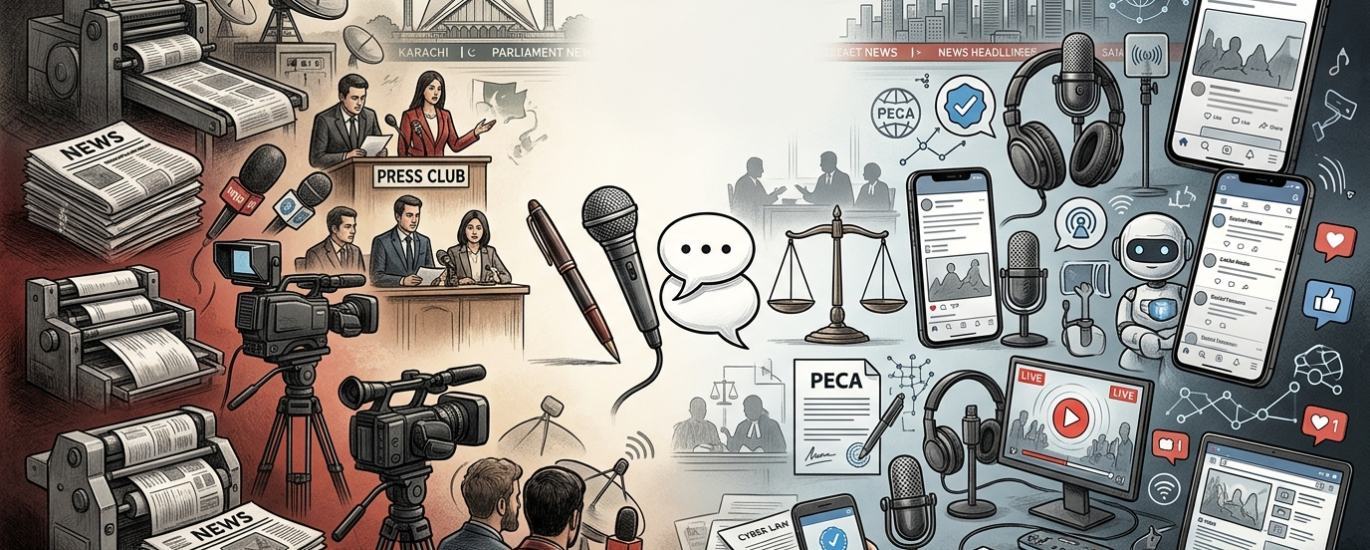
The evolving landscape of media in Pakistan has transformed journalism from a conventional profession into a battlefield of narratives, influence, accountability, and survival. The rise of digital media, independent journalism, social media commentary, and citizen reporting has fundamentally altered how information is consumed and disseminated. While this transformation has expanded the horizon of freedom of expression, it has simultaneously intensified concerns regarding misinformation, propaganda, institutional criticism, and cyber abuse. Within this backdrop, the debate surrounding the Prevention of Electronic Crimes Act (PECA) continues to divide policymakers, journalists, and civil society.
Unfortunately, a dangerous misconception has emerged in recent years: that opposing PECA laws automatically means opposing the state, while opposing certain clauses implies hostility toward state institutions. Such a binary understanding is neither intellectually honest nor democratically healthy. One may support the necessity of cyber laws on humanitarian and national grounds while simultaneously opposing provisions that undermine freedom of expression and the public’s right to information.
As a writer, I firmly believe that PECA, in principle, remains important for the protection of individuals, institutions, and national interests against cyber harassment, blackmail, fake propaganda, hate campaigns, and the reckless spread of misinformation. The digital era demands legal frameworks to regulate cybercrime and protect societal order. However, the concern of the journalistic fraternity revolves around those clauses that may indirectly suppress legitimate criticism, investigative journalism, or independent reporting under the broader interpretation of electronic or cyber regulations.
The state, bureaucratic structure, and institutions require legal safeguards, but democracy equally demands the preservation of dissenting voices and journalistic independence. Journalism cannot survive in an atmosphere where every critical question is perceived as rebellion or anti-state sentiment. At the same time, freedom of expression should not become a shield for malicious disinformation campaigns, character assassination, or politically motivated propaganda. Responsible journalism and responsible governance must coexist.
On World Press Freedom Day, the conference organized by the Karachi Union of Journalists reflected precisely this dilemma faced by Pakistan’s media community. The event brought together journalists, editors, policymakers, and media stakeholders to discuss the growing pressures on independent journalism. One of the most powerful moments of the conferences was the statement by a renowned editor of Daily Dawn who avowed, “Surrender is not an option.” The quote resonated deeply because it captured the emotional and professional struggle of journalists attempting to protect both press freedom and professional integrity in increasingly polarized times.
However, the conversation does not end with resistance alone. During discussions with officials, including the DGPR PID Karachi, an important perspective emerged regarding the intentions of the state toward the journalistic fraternity. The emphasis was not solely on restrictions, but also on responsible journalism within certain national boundaries. There was an acknowledgment that the media plays a vital role in democratic discourse, yet there was also concern that internal conflicts within journalism itself often weaken the profession. Journalists settling personal scores against fellow journalists through digital platforms has become a disturbing trend that damages institutional credibility and creates unnecessary polarization within the fraternity.
This reality cannot be ignored. The media community must also introspect. Press freedom loses moral strength when professional ethics are compromised by factionalism, misinformation, or politically motivated vendettas. A journalist’s responsibility is not merely to oppose power, but to pursue truth with responsibility and discipline.
In this regard, the role of the Sindh Journalists Protection Authority deserves appreciation. Whether addressing false apprehensions against journalists, protecting media workers from unlawful harassment, or pushing media outlets to implement the provincial government’s minimum wage policies, the authority has attempted to bridge the gap between journalistic rights and institutional protection. At a time when many journalists continue to struggle financially despite years of professional service, such interventions are necessary for the survival of ethical journalism.
The issue of salaries and minimum wages remains one of the harshest realities within Pakistan’s media industry. Media houses consistently link their inability to pay journalists adequately with declining revenues and inconsistent advertisement allocations. Their argument remains intact: without increased advertisement revenue, sustainability becomes impossible. While there is truth to the financial crisis confronting print and electronic media, this cannot justify the exploitation of journalists who continue to work under difficult conditions without financial security or legal protection.
- Chairperson of the Sindh Journalists Protection Authority is also a renowned bureaucratic figure & a victim of media trial during his tenure as Secretary.
The speeches delivered by government officials, including the Minister for Information, have repeatedly highlighted the problematic situation surrounding advertisement distribution, particularly within print media. The grievances raised by media outlets over uneven advertisement allocations reveal a deeper structural dependency. Government-sponsored advertisements have now become one of the major sources of financial survival for both print and electronic media organizations. This dependency creates a complicated relationship between media independence and state patronage.
Therefore, the discussion surrounding media reforms must move beyond slogans and protests. If the state genuinely seeks a responsible, professional, and independent media ecosystem, then federal and provincial information department budgets—particularly in Sindh and Punjab—should be expanded strategically to include digital media development. The future of journalism no longer belongs exclusively to television studios or newspaper printing presses. Independent digital platforms, regional social media channels, and online news forums are rapidly becoming influential stakeholders in shaping public opinion.
A structured registration process for digital and verified social media news platforms could significantly expand the media economy while encouraging accountability and transparency. Such reforms may also create the space required for future amendments to controversial PECA clauses after broader consultations with journalists, lawmakers, and civil society representatives.
It is important to note that journalists protesting against certain PECA provisions have consistently appealed to Interior Minister and former journalist Mohsin Naqvi to intervene and facilitate meaningful amendments. Their demand is not the abolition of electronic & cyber laws altogether, but the introduction of legal protections or immunity for journalists operating within the boundaries of professional reporting and public interest journalism.
The political dimension surrounding PECA also remains intriguing. The difference in approach between the federal government and the provincial leadership in Sindh reflects the complexity of Pakistan’s political environment. The provincial ruling party appears neither willing to openly endorse PECA in its controversial form nor aggressively oppose it. Interestingly, despite the ongoing criticism and political targeting on social media directed toward Sindh’s political leadership and governance, there have been no major complaints or lawsuits filed against journalists under PECA from the provincial side. This restraint reflects a nuanced political strategy that avoids direct confrontation with the media fraternity.
At the same time, one cannot deny the growing sense of deterrence among journalists whenever state narratives appear disconnected from ground realities. Journalism often requires uncomfortable questions, difficult investigations, and the release of information that powerful corridors may find inconvenient. Democracies mature not by suppressing criticism, but by tolerating scrutiny while protecting national stability.
Pakistan’s recent “Marka-e-Haq” celebrations and national narratives surrounding institutional unity also demonstrate that civil-military relations continue to seek cohesion and stability in an evolving geopolitical environment. Yet the simultaneous rise of aggressive political criticism on social media, especially targeting politicians and provincial governments, indicates that society itself remains deeply polarized.
The solution, therefore, lies neither in unrestricted digital chaos nor in excessive legal intimidation. Pakistan requires a balanced media framework where misinformation is punished, cyber harassment is controlled, institutions are protected, and journalists are simultaneously guaranteed professional freedom and legal safeguards.
Freedom of expression should not become freedom from responsibility. Likewise, state authority should not become authority over truth itself. The future of Pakistan’s media depends upon finding an equilibrium between these two realities.Top of FormBottom of Form