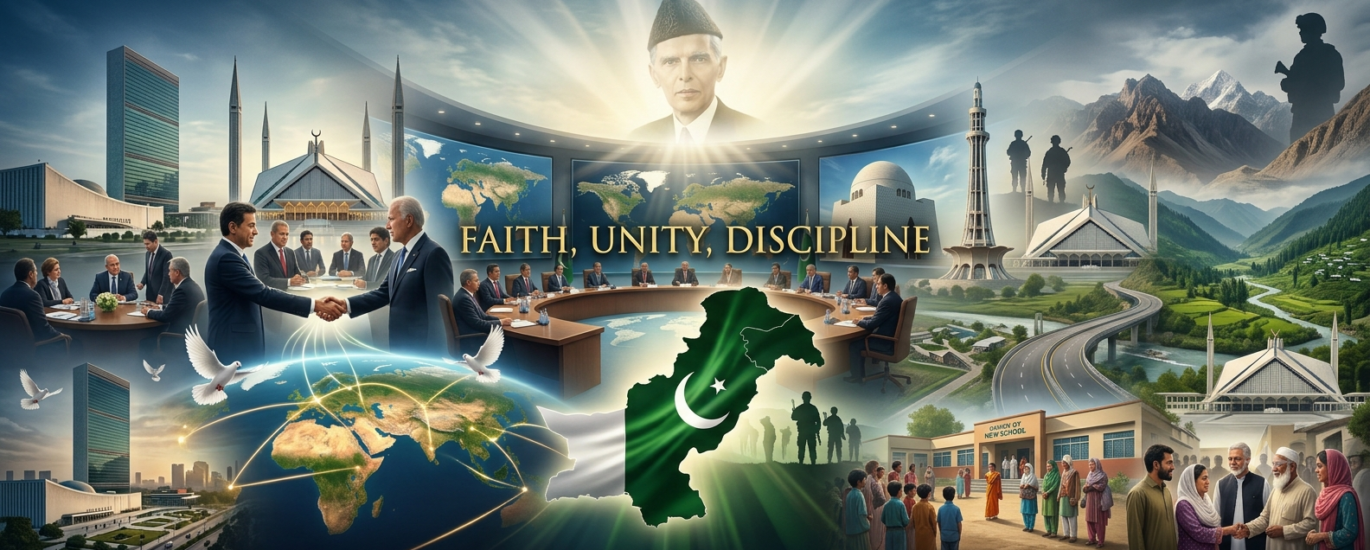
Pakistan’s Emergence as a Credible International Mediator
Pakistan today finds itself occupying a position few could have anticipated a decade ago. From regional diplomacy to international conflict resolution, Islamabad is increasingly being viewed as a credible voice for dialogue and de-escalation. The country’s growing role as a facilitator of peace has led many observers to describe Pakistan as an emerging “Global Mediator” in an increasingly fragmented world order.
International Recognition of Pakistan’s Diplomatic Role
This diplomatic recognition was recently reinforced when United Nations Secretary-General Antonio Guterres appreciated Pakistan’s efforts for promoting peace during his meeting with Interior Minister Mohsin Naqvi. Such acknowledgements reflect a broader international perception that Pakistan is capable of contributing beyond traditional security considerations and can serve as a bridge between competing regional interests.
Global Recognition Amid Regional Uncertainty
Yet history often presents nations with paradoxes. At the very moment Pakistan receives recognition abroad for mediation and peacebuilding, it simultaneously faces complex security and political challenges within its own borders. The resurgence of tensions across the Middle East, particularly the renewed confrontation involving Iran and the United States and the expanding conflict involving Iranian-backed Houthi forces, has once again placed Pakistan in a delicate strategic position. Longstanding civil-military and diplomatic ties with Saudi Arabia, coupled with geographic proximity and historical relations with Iran, leave little room for simplistic choices and demand careful statecraft.
Lessons from Previous Strategic Balancing Acts
Pakistan has encountered similar strategic dilemmas before. During the Yemen conflict in 2015, then Interior Minister Rehman Malik publicly reiterated the Pakistan Peoples Party’s support for Saudi Arabia, reflecting the policy position articulated by PPP Co-Chairman and former President Asif Ali Zardari. Despite Pakistan’s role as a facilitator of regional dialogue and the country’s desire to maintain balanced relations across the Muslim world, strategic realities often compelled difficult decisions. Once again, history appears to be presenting Pakistan with similar tests of diplomacy, balance and national interest.
The Internal Security Dimension
While Pakistan’s diplomatic profile has expanded internationally, the country’s armed forces continue to confront significant internal security pressures. Operations against militancy and insurgency, challenges emerging from interconnected border regions involving Afghanistan, Iran and Balochistan, and persistent attempts to undermine internal stability continue to consume national attention and resources. These realities coexist with the renewed international recognition earned by Pakistan’s military leadership and institutions for restoring the country’s strategic credibility and deterrence posture on the global stage.
Political Polarization and National Cohesion
At the same time, political discourse surrounding national security has become increasingly polarized. Statements targeting state institutions and the memory of martyred officers have generated concern among many segments of society who believe that political disagreement should never come at the expense of national cohesion or respect for sacrifice. External pressures and internal divisions often reinforce one another, creating vulnerabilities that adversaries seek to exploit.
Balochistan and the Question of Inclusion
No discussion regarding Pakistan’s internal challenges can ignore Balochistan. For decades, many observers and stakeholders have argued that the province and its people have remained deprived of the opportunities, infrastructure, educational facilities and economic development that could fully integrate them into Pakistan’s growth story. Roads, universities, healthcare facilities and employment opportunities remain central to any sustainable solution.
Understanding Competing Narratives in Balochistan
As senior journalist Rafiq Bhutto observed during discussions on the subject, one perspective within Baloch society is that the state failed to fully embrace the Baloch people as equal stakeholders in the national project. Yet another perspective highlights the complex realities of terrorism, insurgency, militant infiltration and the involvement of transnational networks operating across porous borders. Any serious national strategy must possess the maturity to acknowledge both realities simultaneously rather than reducing a complex issue to a single narrative.
Governance Challenges in Azad Jammu and Kashmir
Similarly, political unrest and protest movements in Azad Jammu and Kashmir, including those associated with the Jammu Kashmir Joint Awami Action Committee (JAAC), demonstrate the growing pressures facing governance structures in strategically sensitive regions. Whether these movements arise from economic grievances, governance concerns or broader political dynamics, they require dialogue, political engagement and institutional responsiveness rather than prolonged confrontation.
Sindh’s Political Response to National Challenges
In this environment, Sindh’s political leadership has positioned itself firmly in solidarity with the armed forces and national institutions. From Bilawal Bhutto Zardari to Chief Minister Syed Murad Ali Shah, alongside Senior Minister Sharjeel Inam Memon and other members of the provincial cabinet, the Pakistan Peoples Party leadership has strongly condemned remarks directed against martyred army officers and has emphasized respect for national institutions and civil-military harmony.
Coalition Politics and the Limits of Consensus
However, the broader political landscape remains strained. Relations between the federation and provinces continue to face challenges, while tensions among coalition partners have periodically surfaced. Even within the governing alliance, disagreements between major political stakeholders reveal the fragility of Pakistan’s political consensus at a time when unity is needed most.
Revisiting the Founding Principles
This is precisely why Pakistan’s present moment demands a return to the principles upon which the nation was founded: Faith, Unity and Discipline. These were not merely slogans for independence; they were strategic instructions for survival and progress.
Reconciliation as a Strategic Necessity
Today, reconciliation is no longer a political luxury but a national necessity. The federation and provinces, the civilian leadership and military institutions, coalition partners and opposition parties all face a common reality: a divided Pakistan benefits only those who seek instability on its borders and uncertainty within its economy and political system.
The Political Responsibility of National Stakeholders
The Pakistan Peoples Party’s political influence in Balochistan and its growing prospects in Azad Jammu and Kashmir have positioned it as an important stakeholder in national cohesion.
Within this context, the political maneuvering and organizational strategy associated with Faryal Talpur are often viewed by observers as important factors in consolidating alliances, managing electoral dynamics, and preparing the party for future contests, particularly in AJK.
Political strategy and organizational efforts have expanded its influence in regions of strategic significance. Yet electoral opportunities alone cannot address deeper grievances. The concerns raised by protest movements such as JAAC require collective engagement involving provincial governments, the federal government and national institutions working toward consensus rather than confrontation.
Global Responsibilities Require Domestic Stability
Pakistan has entered an era in which it is expected to mediate global disputes while simultaneously confronting domestic challenges of governance, security and political polarization. Nations entrusted with international responsibility cannot afford internal fragmentation.
A Choice Between Division and Renewal
The choice before Pakistan is therefore straightforward. Continue allowing political acrimony, institutional distrust and provincial divisions to dominate national discourse, or rediscover the principles that carried the country through previous crises.
Becoming a Mediator Within Our Own Borders
At a time when the world increasingly looks toward Pakistan as a mediator, Pakistan itself must become a mediator within its own house.
The Hour Demands Reconciliation
The hour demands reconciliation.
The moment demands responsibility.
And above all, the nation must once again reunite with faith and discipline.