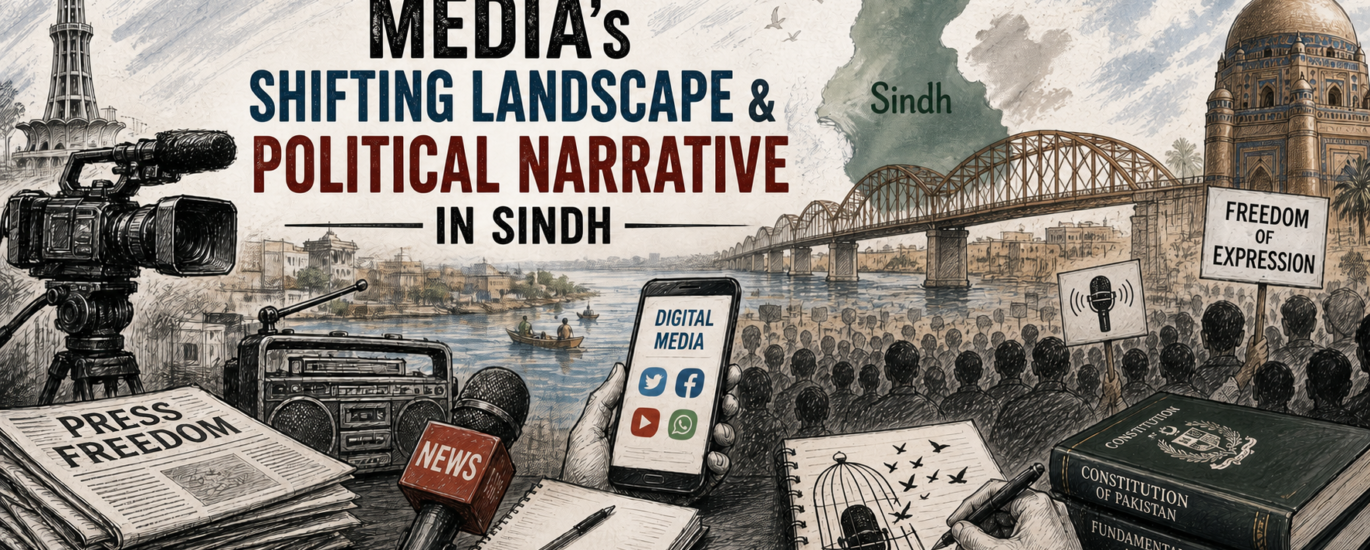
As a student of media & politics, we, along with the entire world, observe World Press Freedom Day on 3rd May of each year. On this day, some might celebrate, but as an individual, this day is often reserved to open up the wounds of the past & recall the incidents that changed the entire landscape of media & specifically, the journalism industry. Undoubtedly, these wounds & incidents helped us in shaping the character to confront the hardlines with uncompromised dignity, integrity, and democratic continuity. 3rd May carries particular weight, as the media operates within an environment that is dynamic, sensational, and deeply contested.
Journalism in Pakistan has long been defined by its persistence. Reporters, editors, and digital content creators continue to inform the public despite facing pressures that range from economic constraints to security risks. Investigative reporting and critical commentary remain vital components of the country’s media output, demonstrating that the spirit of free expression endures. Yet, this resilience coexists with an undeniable reality: the operational space for media is increasingly constrained.
A central issue shaping this environment is the Prevention of Electronic Crimes Act (PECA). Initially introduced to address cybercrime, the law has evolved into a focal point of debate over digital rights and freedom of expression. Its provisions- particularly those dealing with online content have been criticized for being overly broad & leaving room for subjective interpretation. This ambiguity has resulted in its application against journalists, activists, and political commentators, raising concerns about its potential to discourage open discourse.
From a legal standpoint, questions have been raised about whether certain aspects of PECA align with constitutional protections for free speech. The concern is not about the necessity of regulation itself-few would dispute the need to counter misinformation, cyber harassment, and online fraud, but rather about how such regulation is framed and enforced. Laws that lack precision risk being perceived as instruments of control rather than safeguards of public interest.
At the same time, it is essential to recognize the growing challenges within the digital sphere. There’s a thin line that differentiates between content creators and journalists. However, the rapid evolution and expansion of online platforms have amplified issues such as disinformation campaigns, identity theft, and cyber-enabled financial crimes. In this regard, the formation of the National Cyber Crime Investigation Agency (NCCIA) marks a noteworthy step to address these threats. Undoubtedly, their role is significant in an era where cybercrime can undermine economic stability and public trust.
From a journalist’s perspective, I believe there’s a requirement to oversee certain clauses, or a journalist should be given immunity on freedom of expression-related clauses in the PECA Act. Prominent journalist leaders have been requesting Interior Minister & former journalist Mohsin Naqvi to intervene & contribute to reforming the PECA Act. I have no evidence to prove the intention behind this necessary reform. However, the Sindh government neither disowned nor endorsed this controversial act. The remarks of PPP’s Provincial President, Sr. Minister of Information, and the Chief Minister’s interest, along with the financial contribution of the government, and in addition, the Sindh government has not filed a single complaint against any of the journalists under the controversial PECA Act. This is a testament that the ruling political party of Sindh has been with the journalist fraternity.
However, the grievances of journalists exist. Internal rifts and divisions within the fraternity have occurred with the divisions of political individuals. Defaming a colleague has become a culture that should be addressed and constituted within the framework & constitution of journalistic associations.
I have been a critic of the media’s downfall and the dark, controversial laws imposed in the Pakistan Tehreek-e-Insaf regime. Their people often consider this criticism as personal, while the intention of the criticism is to recall their past mistakes. My deepest sympathies are with the former chief of PTI, but today his people are reaping what their leader has sown. Everyone is equal in front of the law, but one should not forget that the same laws apply to their political party representatives.
In addition, I would like to remind the enforced closure of Channel 24 & City Group, which is still owned by the interior minister. Thousands of people were displaced, which ignited the protests throughout the country. However, we were protesting right in front of the governor’s house in Karachi, and Imran Ismail sb did not even come out to hear us. Today, everyone knows what has happened and how that happened. It was clear that the Pakistan Tehreek-e-Insaf forced Mohsin Naqvi to bow down in front of the government; he refused, which led to the confrontation between the state and the business owner. As history portrays, a business owner cannot win in the conflict with the state, no matter how powerful or financially strong a person is. Even in those times, PPP Information Minister Syed Nasir Hussain Shah stood with the media channel workers. In this regard, the son of a renowned union leader & former Minister of Information, Saeed Ghani’s contribution is commendable for safeguarding the journalist’s rights.
In a similar context, I don’t doubt the Federal Minister of Information & Broadcasting’s intentions towards imposing the laws. The public has seen how he welcomed & respected a grieving person from Sindh and gave him another life with an appointment at PTV. His efforts are appreciated by the public and the journalist fraternity. At the Same time, a journalist fraternity criticizes PML-N for the treatment during an amendment of the PECA Act. Consulting with the fraternity leaders an hour before presenting a bill in the National Assembly shows that the Ministry of Information & Broadcasting does not value them, or, preferably, the government took them for granted.
I apologize in advance, but today the PECA Act has lost credibility & is seen as a threat rather than a protection of the journalist’s rights. This Act has become controversial just like the Kala Bagh Dam Project. This suggests that the government & institutions must consider their request for immunity under PECA Laws and initiate the formation of new laws, particularly for the media & journalist fraternity.
As the President’s message on World Press Freedom Day states, “We also honour those journalists who have laid down their lives in pursuit of the truth, especially in the conflict zones. I call upon the federal and provincial governments to ensure enabling laws and a safe environment for journalists.”
Respectfully, Mr. President, you promised that you would leave a better Pakistan behind. Unfortunately, the Pakistan we live in sometimes acts cowardly when a journalist asks a question or raises a difference between the rule of law and rule by law.
With the deviations or differences between the Government Partners, Policymaking has also become a tool to safeguard an individual’s political gain. Similarly, Federal & Provincial Political narratives over several policies are perceived differently. This calls for a policy & political narrative alignment.