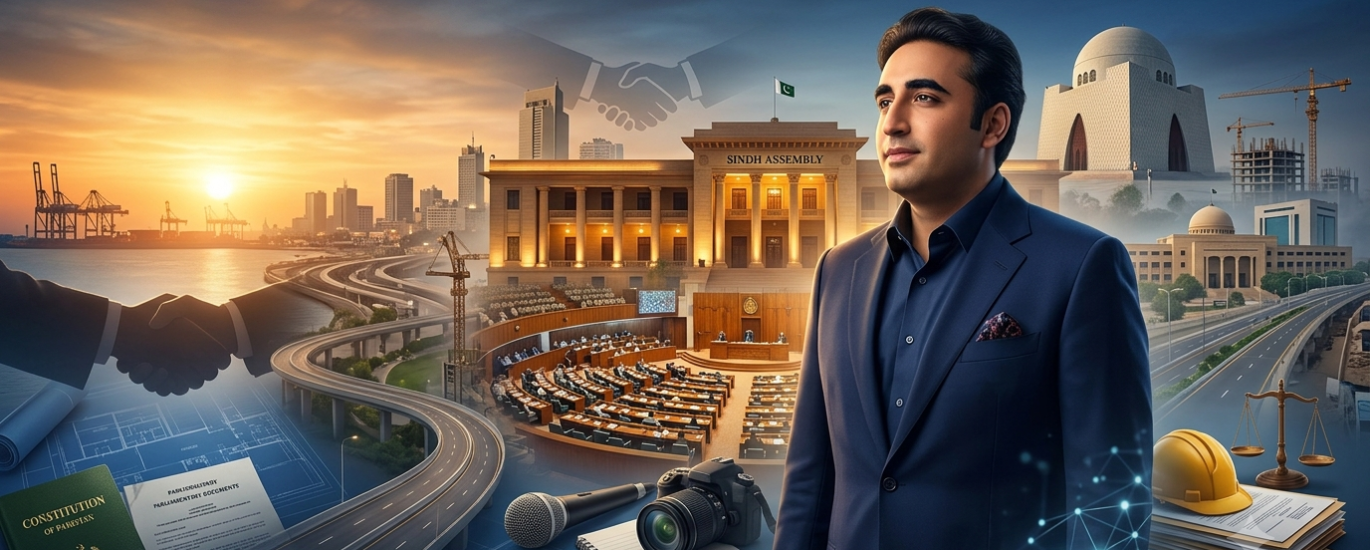
Bilawal Bhutto’s Political Advice Appears Reflected in Sindh’s Parliamentary Conduct
Pakistan’s political discourse has long been characterized by confrontation rather than constructive engagement. However, the recent proceedings of the Sindh Assembly presented a comparatively different political atmosphere, where disagreement coexisted with parliamentary decorum. While sharp exchanges remained part of the democratic process, the overall tone suggested that political maturity can prevail without undermining institutional dignity.
This development also appears to resonate with Pakistan Peoples Party (PPP) Chairman Bilawal Bhutto Zardari’s recent suggestion to Prime Minister Shehbaz Sharif that greater control over the federal cabinet would contribute to smoother governance. Whether directly connected or not, the latest provincial assembly session demonstrated that disciplined political engagement can produce healthier legislative outcomes.
PPP and MQM: Competition Without Parliamentary Breakdown
The most notable feature of the session was the interaction between the treasury and opposition benches.
MQM-Pakistan MPA Muhammad Taha presented his criticism of the provincial government, while PPP senior leader and Labour Minister Saeed Ghani responded with a comprehensive political and administrative defense. Despite clear political differences, both sides largely maintained parliamentary norms, illustrating that democratic disagreement need not translate into institutional hostility.
The exchange reflected an encouraging political reality: governments and opposition parties can contest policies while preserving the dignity of the legislative forum.
Meanwhile, PPP Chairman’s Political Secretary and MPA Jameel Soomro also addressed the House. Although his remarks appeared less structured than those of senior parliamentary figures, the speech conveyed sincerity and political conviction. Rather than reading as a carefully scripted address, it reflected a spontaneous expression of party loyalty and political commitment.
Development Funds Remain at the Center of the Political Debate
Political analyst and Director of Political & Current Affairs, Hamari Web, Rafiq Bhutto, during a recent discussion, argued that the disagreement between PPP and MQM primarily revolves around development funding rather than purely political rivalry.
According to his analysis, MQM has sought greater involvement of the federal government in financing development projects, particularly in urban Sindh. Conversely, the PPP leadership, including the provincial finance authorities, has maintained that development planning should remain consistent with the constitutional framework of provincial autonomy.
From this perspective, the debate is not simply about financial allocations but about preserving provincial authority over development priorities following the constitutional devolution of powers.
Rafiq Bhutto further suggested that political activity involving individuals associated with MQM-London has increased through informal channels, indicating the possibility of evolving political dynamics in Karachi. These observations represent his analysis and remain part of the broader political discussion rather than independently verified developments.
Media Narratives and the Question of MQM-London’s Political Relevance
Political discussions within Pakistan’s media continue to debate whether MQM-London retains residual political influence among segments of Karachi’s Urdu-speaking population.
Various commentators and analysts have argued that emotional and historical affiliations with Altaf Hussain continue to exist among some supporters, despite the organizational transformation of urban politics over recent years. At the same time, electoral politics in Karachi have become considerably more fragmented, involving multiple political stakeholders.
Whether these evolving narratives ultimately translate into measurable electoral gains remains uncertain and will likely depend on future political developments.
Government Benches Focus on Governance and Development
The treasury benches largely emphasized administrative performance rather than political confrontation.
Provincial Minister Nasir Hussain Shah highlighted ongoing infrastructure and development initiatives across Karachi while also responding to opposition criticism with measured political humor. His remarks suggested that effective development is achievable when political stakeholders cooperate with clarity and mutual understanding.
He also reiterated the PPP government’s position that Article 140-A of the Constitution has been implemented in the province through continued support for local government institutions.
The overall tone of his address indicated that political coordination, rather than perpetual confrontation, remains essential for sustainable urban governance.
Saeed Ghani’s Political Standing and the Labour Reform Challenge
The continuing public discussion regarding MQM-London’s potential political relevance has, in some respects, strengthened Saeed Ghani’s own position within Karachi’s political landscape.
Within the PPP, he continues to enjoy organizational support from party leadership and cabinet colleagues. Simultaneously, he remains engaged in addressing legal matters concerning the Labour Department through constitutional and judicial mechanisms.
His parliamentary address also reiterated the importance of implementing labour laws more effectively across Sindh.
However, one issue continues to attract attention: ensuring that media workers receive salaries consistent with the government’s notified minimum wage.
Sharjeel Inam Memon, Media Policy, and Budgetary Constraints
Information Minister Sharjeel Inam Memon also used his speech to outline departmental achievements while reaffirming the PPP’s commitment to freedom of expression and media development.
Nevertheless, one of the most closely watched commitments remains his earlier assurance that media workers would receive salaries in accordance with the government’s minimum wage policy.
According to informed sources, the Information Minister has continued efforts toward fulfilling this commitment. However, implementation has reportedly faced resistance from sections of the media industry, where some media owners have sought increased government advertising allocations as part of broader financial negotiations.
The minister has also reportedly expressed concerns regarding the existing advertisement distribution mechanism, particularly in relation to print media.
Digital Media Expansion Requires a New Budgetary Approach
The financial challenges facing Sindh’s Information Department extend beyond conventional media support.
As Pakistan’s digital media ecosystem continues to expand, integrating digital news organizations into formal regulatory and registration frameworks will inevitably require additional financial resources.
Consequently, the issue of media workers’ salaries cannot be viewed in isolation. Sustainable implementation of wage policies, institutional support for traditional media, and the inclusion of digital media platforms are interconnected policy objectives that require comprehensive financial planning.
Budgetary limitations therefore remain one of the principal obstacles to achieving these reforms.
A Shared Responsibility Beyond Sindh
The challenge of implementing minimum wage protections for media workers is not solely a provincial issue.
Provincial information departments, labour departments, and the federal Ministry of Information and Broadcasting all share responsibility for ensuring that statutory labour protections are implemented effectively within the media industry.
Greater coordination between provincial Labour Ministries and Information Ministries could establish a more practical framework for enforcing minimum wage laws while supporting the long-term sustainability of Pakistan’s media sector.
Conclusion: A More Constructive Democratic Direction
The recent Sindh Assembly session demonstrated that political disagreement need not undermine democratic institutions.
Although ideological differences between PPP and MQM remain substantial, parliamentary exchanges suggested that political competition can coexist with institutional respect.
The session also highlighted broader governance challenges—from constitutional questions surrounding provincial autonomy to labour rights, media sustainability, digital transformation, and fiscal management.
Ultimately, democratic governance is strengthened not when political disagreement disappears, but when disagreement is expressed responsibly within constitutional institutions. If this parliamentary tone continues, it may represent a constructive evolution in Sindh’s political culture, where governance increasingly takes precedence over perpetual political confrontation.