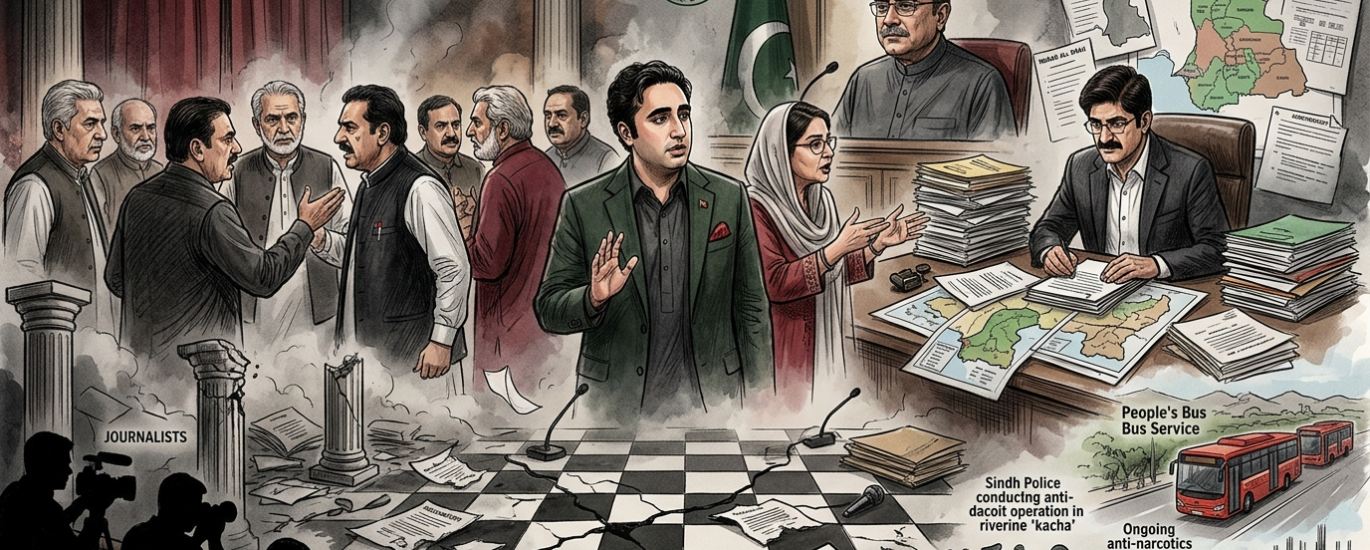
Politics, in its democratic essence, is meant to provide governance, stability, and collective direction. Yet in Sindh today, the most formidable political opposition confronting the ruling party does not appear to emerge from rival benches alone; rather, it is increasingly developing from within the party’s own internal structure. The widening public acrimony among influential leaders has transformed political disagreements into spectacles of institutional confrontation, weakening governance, organizational discipline, and public confidence alike.
The recent walkout by the former custodian of the house, Member of the Provincial Assembly, Chairman of the Public Accounts Committee, and Provincial President of the ruling party, was not merely a symbolic parliamentary protest. It represented a visible manifestation of tensions that had reportedly been simmering for months. The heated exchange between the Provincial President and the Speaker of the Assembly was linked to the controversial transfer of the Secretary of the Public Accounts Committee amid allegations of corruption and administrative interference. Yet, like every political conflict, this controversy carries two competing narratives.
One side alleges that the Chairman and Secretary of the Public Accounts Committee were themselves involved in matters relating to financial and administrative irregularities. The opposing narrative claims that the Speaker was attempting to amend certain laws and administrative procedures in ways that could allegedly provide indirect political or personal benefit. Political observers and journalists further suggest that the rift did not suddenly emerge following the secretary’s transfer; rather, the hostility had reportedly been escalating for nearly three months before it surfaced publicly.
Another version of events paints an even more troubling picture of institutional vulnerability. According to certain reports, there existed an understanding between the PAC Chairman and the Secretary that the latter would be protected while pursuing recoveries and inquiries involving individuals allegedly connected with influential politicians. If such reports carry truth, then the subsequent transfer of the Secretary conveyed a deeply damaging political message: that even senior leadership figures within the ruling structure cannot guarantee institutional commitments.
Such developments create long-term consequences for governance itself. Officers tasked with accountability proceedings may become increasingly reluctant to pursue sensitive financial recoveries if they believe institutional backing can disappear under political pressure. Accountability mechanisms cannot function effectively when administrative officers fear political repercussions for pursuing uncomfortable truths.
Adding further complexity were reports regarding the closure of an alleged “shop” operating inside the assembly premises. These allegations naturally raise larger constitutional and administrative questions. If irregularities truly existed within the Public Accounts Committee structure, then whether the Finance Minister – serving as a constitutional ex officio member of the committee alongside the Chief Minister- was consulted or informed becomes a matter of legitimate public interest.
The legal interpretation of an ex officio member is particularly important here. An ex officio member becomes part of a committee or institution by virtue of holding a constitutional or administrative office. Such membership is not ceremonial; it carries participatory and supervisory responsibilities tied directly to governance and accountability. Therefore, any institutional controversy surrounding the Public Accounts Committee inevitably raises questions regarding the awareness and oversight responsibilities of its ex officio member.
Unfortunately, the PAC controversy is not an isolated chapter. Sindh’s political environment has increasingly witnessed internal disputes, factional rivalries, and public allegations involving influential members of the ruling structure itself. The visible tensions involving Sharjeel Inam Memon and Jam Khan Shoro, disputes associated with Jameel Soomro and Sohail Anwar Sial, influential political groups in Larkana, and the on-record allegations raised by former Lyari Chairman Nasir Kareem against Murtaza Wahab, Junaid Saleem JD, and Nabil Gabol collectively portray an atmosphere of deepening fragmentation.
What makes these developments politically significant is that Nasir Kareem simultaneously acknowledged the support and encouragement of Faryal Talpur and Saeed Ghani before tendering his resignation. While criticizing other influential figures, this does not merely indicate factional politics; it reflects the emergence of organic criticism from within the party’s own political ecosystem.
Simultaneously, another troubling pattern has become increasingly visible: prominent cabinet members appear compelled to distance themselves from their closest associates and trusted team members amid growing controversies. Criticism directed toward Syed Nasir Hussain Shah has frequently extended beyond the minister himself to include attacks on his sons and associates, creating the impression that portions of social media criticism may not entirely reflect genuine public sentiment. Similar administrative disruptions have reportedly affected other departments as well, including developments involving Khuhro and the PAC Secretary, while administrative reorganizing in the Information and Transport ministries further reinforces perceptions of instability.
Yet perhaps the most politically dangerous development is the growing perception among several prominent tribes and regional political groups that they are being systematically neglected despite their long-standing political loyalty and electoral contributions. The concerns are no longer limited to individual politicians; they now extend into the broader tribal and social fabric of Sindh.
Political observers increasingly point toward dissatisfaction among influential tribal and regional leadership circles associated with figures such as Sohrab Khan Sarki, Imtiaz Ahmed Shaikh, and the Bijarani political family from Kandhkot-Karampur. These are not politically insignificant names. They represent constituencies, tribal influence, and electoral structures that have historically contributed toward strengthening the ruling party’s organizational foundation in Upper Sindh.
The perception of neglect among such influential groups creates a dangerous political vacuum. In Sindh’s political landscape, tribal relationships, regional representation, and political recognition remain deeply interconnected with electoral stability. When influential stakeholders begin feeling politically marginalized, the consequences extend beyond internal dissatisfaction; they gradually weaken organizational cohesion at the grassroots level.
The issue is not merely about ministries, portfolios, or ceremonial positions. It is about political inclusion, administrative access, developmental prioritization, and respect for regional political stakeholders who believe they have remained loyal during difficult political periods. If these grievances continue to accumulate without meaningful engagement, the ruling structure risks alienating precisely those regional power centers that historically served as pillars of electoral support.
In this broader climate of uncertainty, many aggrieved members reportedly see no avenue for political reconciliation other than approaching Faryal Talpur, whose role increasingly appears to extend beyond organizational leadership into crisis management and reconciliation. Political sources further suggest that the ongoing anti-narcotics campaign within Sindh is no longer confined to external criminal networks alone. This time, the intention appears to include internal accountability as well. Reports indicate that party members allegedly linked to narcotics networks or criminal patronage structures may no longer receive political protection regardless of influence or affiliation.
At the same time, it would be politically unfair to ignore the government’s administrative achievements. The federal recognition awarded to Zia Lanjar through the Sitara-e-Imtiaz for contributions towards maintaining law and order, anti-narcotics operations, and action against dacoit networks reflects acknowledgment of serious security efforts. Likewise, Sindh Police Chief Javed Alam Odho, receiving the Tamgha-i-Imtiaz for successful operations in kacha areas, demonstrates that governance efforts are producing visible results in critical sectors.
Similarly, the expansion of the People’s Bus Service remains among the government’s most publicly appreciated flagship initiatives. Extending transport services into politically sensitive or opposition-supporting regions demonstrates an important democratic principle: governance must not discriminate between supporters and opponents. Yet political contradictions remain visible. While services expand into some areas, citizens from regions such as Thari Mirwah continue raising concerns regarding inadequate health, education, and transport infrastructure despite those constituencies falling within politically influential territories.
An important anecdote often attributed to Asif Ali Zardari offers a valuable lesson in democratic governance. During discussions regarding infrastructure development, a minister reportedly suggested that a proposed overhead bridge primarily served areas inhabited by followers of Pir Pagara and supporters of rival political parties. The response allegedly given by the President reflected political maturity: opposition supporters are also citizens who deserve equal access to development and public facilities.
Today, however, Sindh’s ruling structure stands at a politically delicate crossroads. The Chief Minister faces mounting financial and administrative pressures, while party members continue demanding development, recognition, and organizational attention. Internal rivalries, factional narratives, tribal dissatisfaction, institutional confrontations, and public allegations collectively risk creating an atmosphere of political chaos that could gradually erode governance credibility.
The Chairman of the ruling party and President Zardari remain occupied with national-level political responsibilities, leaving senior figures such as Faryal Talpur and the First Lady to navigate increasingly complex provincial disputes. Yet internal breakages cannot be managed indefinitely through temporary political balancing alone.
The ruling party must recognize a difficult but unavoidable reality: prolonged internal acrimony weakens governance, damages institutional confidence, discourages administrative accountability, alienates loyal stakeholders, and creates political space for opponents. When a ruling party begins performing the role of its own opposition, democratic authority gradually transforms into administrative instability.
Sindh does not merely require political management; it requires political maturity, institutional discipline, and inclusive governance. The leadership must move decisively toward reconciliation, accountability, regional inclusion, and development-oriented governance before these internal disputes evolve into a larger and potentially irreversible political disaster.