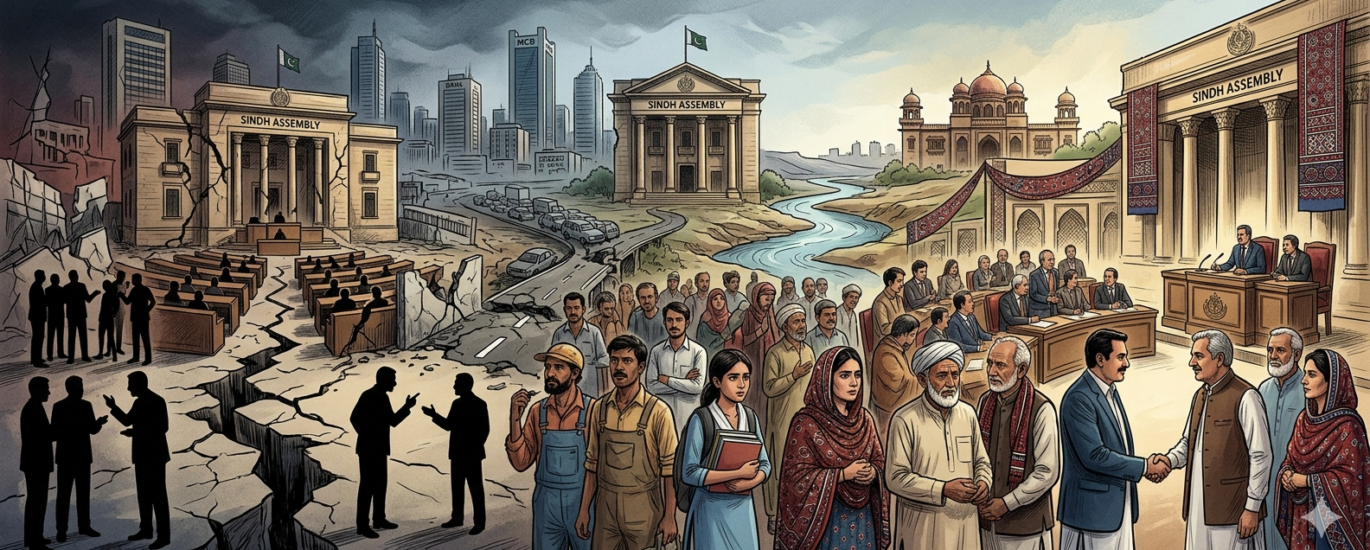
Politics is not merely a contest for power; it is a responsibility of representation. In parliamentary democracies, political workers, students, and ordinary citizens often shape their opinions, loyalties, and aspirations around the conduct of their elected leaders. Politicians are not isolated individuals operating behind closed doors; they are public figures whose behavior directly influences the public psyche, organizational culture, and democratic confidence of the masses. When political disagreements evolve into public confrontations, personal camps, and media spectacles, the damage is not restricted to one party alone — it weakens democratic credibility itself.
In the prevailing political atmosphere of Sindh, the internal rifts within the ruling political wing have repeatedly surfaced in public discourse. What could have remained matters of internal consultation and institutional discipline instead transformed into media controversies, social media narratives, and factional alignments. The opposition, ironically, appears less aggressive than the ruling party’s own internal divisions. At times, it feels as though the ruling party itself has assumed the role of both government and opposition simultaneously.
This situation demands urgent political maturity and structural reform.
At the same time, one must acknowledge that the intervention and mediation efforts undertaken by Faryal Talpur reflect an important democratic characteristic: the willingness of top leadership to hear grievances, neutralize conflicts, and preserve party cohesion before confrontations spiral beyond repair. In political organizations where egos, constituencies, influence, and legacy politics often collide, mediation itself becomes an act of statesmanship.
The first major rift that emerged into the public eye involved the confrontation between the Chairman of the Public Accounts Committee and the Speaker of the Sindh Assembly. The matter escalated to the extent that political observers began viewing it not as a routine institutional disagreement but as a symbolic battle of authority and influence within the party structure itself.
Eventually, the matter reached its political conclusion when the PAC Chairman appeared to accept the reality that the top leadership had chosen to stand with the Speaker. More significantly, the controversy highlighted the PAC Chairman’s inability to politically shield a member of his assistance team during the conflict. In parliamentary politics, such moments are often interpreted as indicators of shifting internal influence.
Yet, despite the outcome inside the assembly, the PAC Chairman still appears to retain considerable political strength outside the parliamentary arena. His influence among workers and supporters remains relevant, and this distinction between institutional defeat and public relevance is important in understanding Sindh’s political culture.
On the other hand, the Speaker handled the controversy with visible political maturity. Rather than allowing the issue to permanently fracture the party atmosphere, the matter was gradually neutralized through restraint and institutional calmness. That restraint deserves recognition because political authority is tested not only by how power is exercised, but also by how conflict is contained.
The second confrontation — involving Surrender Valasai and Arbab Lutfullah — unfolded differently. Here, the conflict exposed deeper frustrations and hidden grudges among members that had apparently existed beneath the surface for quite some time. The episode demonstrated how internal disagreements can gradually transform into larger political resistance when individuals feel unheard or politically cornered.
At one stage, it seemed inevitable that the weaker political side would eventually surrender before stronger organizational influence. However, the controversy unexpectedly evolved into a precedent of resistance, where members displayed willingness to speak openly, challenge internal pressure, and even risk resignation to confront influential politicians.
Such developments are significant because they reveal an emerging political culture within party structures: one where silence is no longer guaranteed merely because hierarchy exists.
It was again Faryal Talpur who intervened to contain the matter. Her intervention ultimately brought the conflict to a close, and the influential political figure involved chose to step back in front of the party’s senior leadership. In my opinion, this was a sensible and politically mature decision. Sometimes retreating from escalation is not weakness; it is wisdom. Political survival in democratic systems often depends on knowing when confrontation strengthens the party and when it weakens it.
However, the third and perhaps most sensitive confrontation remains unresolved — the political friction between the Memons and the Shoros of Hyderabad. Unlike previous disputes, this issue has not been openly disclosed by the top leadership despite widespread public speculation and media controversy.
Although the public blame-games and confrontational media narratives have somewhat slowed down, the matter itself still appears unresolved within the court of party leadership. The silence surrounding the controversy perhaps indicates the sensitivity of the issue because it involves not just individuals, but influential political families with long-standing organizational roots and regional influence.
What makes this controversy more complicated is its overlap with the recurring allegations surrounding the Sindh Public Service Commission controversy, where accusations of non-merit recruitments once again entered public discussion. Here lies the contradiction that continues to raise uncomfortable questions.
On one side, politicians speak of organizational discipline, merit, and democratic values. On the other side, there are continuing demands for accommodation in appointments, particularly regarding positions from BPS-01 to BPS-04 scale for workers belonging to Hyderabad. The very figure expected to mediate political reconciliation are themselves reportedly requesting administrative accommodations for their supporters.
This controversy raises difficult but necessary questions about meritocracy, political legacy, and institutional fairness. Can political continuity and merit coexist? Can influential political families ensure opportunities for future generations without compromising institutional credibility? These are not simple questions, but they are unavoidable ones.
If evaluated through political maturity rather than emotional loyalty, it appears likely that the eventual political verdict may favor the Memons. Their organizational positioning, media handling, and broader influence seem comparatively stable at this stage. Nevertheless, any final decision by the leadership will inevitably establish a precedent for future political family dynamics within the party.
Another dimension of the ongoing political crisis involves Syed Nasir Hussain Shah and his political circle, which has increasingly become the target of organized criticism across social media platforms. The attacks are no longer limited to political performance alone. At times, critics drag family members into controversies, target his elder son, Ali Shah, question the positioning of Kumail Hyder Shah, who is also a potential political successor, and criticize close team members associated with him.
The pattern of criticism often appears too systematic to be entirely organic. It increasingly resembles strategic political targeting rather than spontaneous public accountability. Whether these narratives are politically motivated or partially grounded in reality is difficult to conclusively prove, yet perception itself carries enormous political consequences.
Moreover, statements emerging from local political figures in Lyari have further complicated the atmosphere by indirectly exposing alleged networks of systematic beneficiaries. These claims may remain impossible to legally establish, but when such accusations emerge from within the party itself, they naturally generate public suspicion and internal discomfort.
Meanwhile, Saeed Ghani appears politically constrained in Karachi’s evolving landscape. His political space seems affected by his decision to step back and support the Mayor and the Local Government Minister rather than aggressively asserting independent political positioning. While such restraint may reflect organizational discipline, it also risks weakening his distinct political identity among workers who expect visible leadership during turbulent periods.
The broader concern, however, is not about individual victories or defeats. It is about the institutional culture emerging within the political wing itself. The constant surfacing of internal conflicts in media headlines gradually damages organizational sanctity. Workers become confused. Supporters become divided. Opponents become empowered. Most importantly, public confidence in democratic seriousness begins to weaken.
Political parties cannot survive long-term on charisma alone. They require systems, codes of conduct, accountability mechanisms, conflict-resolution forums, and institutional discipline. Internal disagreements are natural in every democratic organization, but unmanaged disagreements eventually become political liabilities.
The current situation in Sindh, therefore, calls for structural reforms within the political wing itself. A clearly defined internal code of conduct is essential. There must be institutional mechanisms for dispute resolution before matters reach media controversies. Internal accountability should apply equally across influential families, ministers, parliamentary figures, and organizational workers. Merit-based frameworks must be strengthened so that allegations of favoritism do not repeatedly undermine public trust.
Most importantly, the attention of the Chief Minister, Faryal Talpur, the Chairman, and the President of the party is urgently required for speedy and decisive conclusions regarding these confrontations. Delayed resolutions only deepen factionalism and encourage parallel power centers within the organization.
Sindh’s political future cannot afford perpetual internal warfare disguised as democratic disagreement. Democracy flourishes through debate, but it weakens when every disagreement transforms into a public power struggle. The ruling party carries not only electoral responsibility but also institutional responsibility toward governance, political stability, and democratic culture.
If the party leadership succeeds in neutralizing these confrontations with fairness, merit, and political wisdom, it will strengthen both the organization and democratic confidence in Sindh. However, if unresolved rivalries continue to dominate headlines, the long-term damage may extend far beyond internal politics.
The time has come for political maturity to prevail over factional impulses. Internal neutrality cannot remain a temporary arrangement; it must evolve into a permanent culture of institutional discipline, responsible leadership, and democratic cohesion.