A City Once Again Caught in Political Confrontation
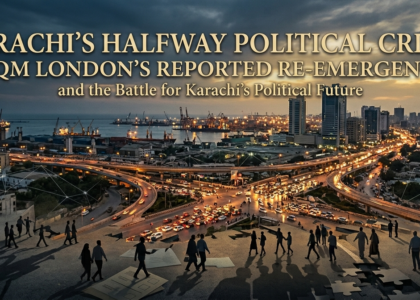
Karachi once again finds itself trapped within an intensifying political confrontation as the relationship between the Government of Sindh and opposition parties continues to deteriorate. Recent criticism by leaders of the Muttahida Qaumi Movement-Pakistan (MQM-P), particularly Farooq Sattar and Waseem Akhtar, over illegal constructions, encroachments, and administrative failures in Karachi has further escalated the political temperature of the province.
The MQM leadership directly held the Sindh government responsible for the growing urban disorder while simultaneously urging Jamaat-e-Islami to actively raise its voice on these issues.
Yet the current political rhetoric reveals a deeper reality: Karachi’s governance crisis is not the burden of a single government, a single political party, or a single administrative tenure. The city’s institutional collapse, unregulated urban expansion, land encroachments, and fragmented governance structures are historical problems rooted in decades of political rivalry, administrative overlap, and inconsistent urban planning.
The political confrontation between MQM and the Pakistan Peoples Party (PPP) has now crossed beyond routine criticism and entered a phase of strategic political positioning, where every issue in Karachi is increasingly becoming part of a larger struggle for political relevance, bargaining power, and urban influence.
Jamaat-e-Islami’s Historical Position and the Question of Shared Responsibility
Interestingly, while MQM now seeks broader opposition alignment against the Sindh government, Jamaat-e-Islami itself has historically criticized both PPP and MQM simultaneously over Karachi’s governance failures.
This political context becomes important because Karachiites are fully aware of the city’s painful past, even if political sensitivities often prevent open acknowledgment of specific realities.
Karachi’s political environment has undoubtedly changed over time. Political tactics, electoral equations, and institutional relationships are no longer the same as they were during the violent decades of ethnic polarization, territorial politics, and armed influence.
Every political force today deserves equal democratic opportunity to serve the people within constitutional and political boundaries. However, historical accountability cannot selectively begin from the present moment while ignoring the past.
In this context, it becomes essential to revisit one of the most significant constitutional petitions ever filed regarding Karachi’s governance crisis: the landmark case commonly known as Naimatullah Khan vs Federation of Pakistan (Constitution Petition No. 9 of 2010).
The Petition That Exposed Karachi’s Administrative Collapse
The petition was filed by former Karachi Nazim and senior Jamaat-e-Islami leader Naimatullah Khan under Article 184(3) of the Constitution before the Supreme Court of Pakistan. The case eventually evolved into one of the most consequential judicial proceedings concerning Karachi’s governance, encroachments, land use, transport failures, and civic collapse.
The petition broadly argued that Karachi’s infrastructure had deteriorated to dangerous levels, public land and amenity plots were being illegally occupied, master plans were continuously violated, transport systems had collapsed, and constitutional rights of citizens were being undermined due to administrative negligence and institutional failure.
Over time, the proceedings expanded beyond a single grievance and effectively became a continuing judicial oversight mechanism on Karachi’s urban governance.
The significance of this case lies in the timing itself. The petition was filed during a period when MQM remained deeply influential within Karachi’s administrative structure.
This alone demonstrates that allegations concerning illegal constructions, land misuse, and encroachments were never exclusively directed toward the present Sindh government. Rather, they reflected a much broader pattern of systemic governance failure involving multiple political eras and administrative stakeholders.
Illegal Constructions: A Crisis Beyond Political Narratives
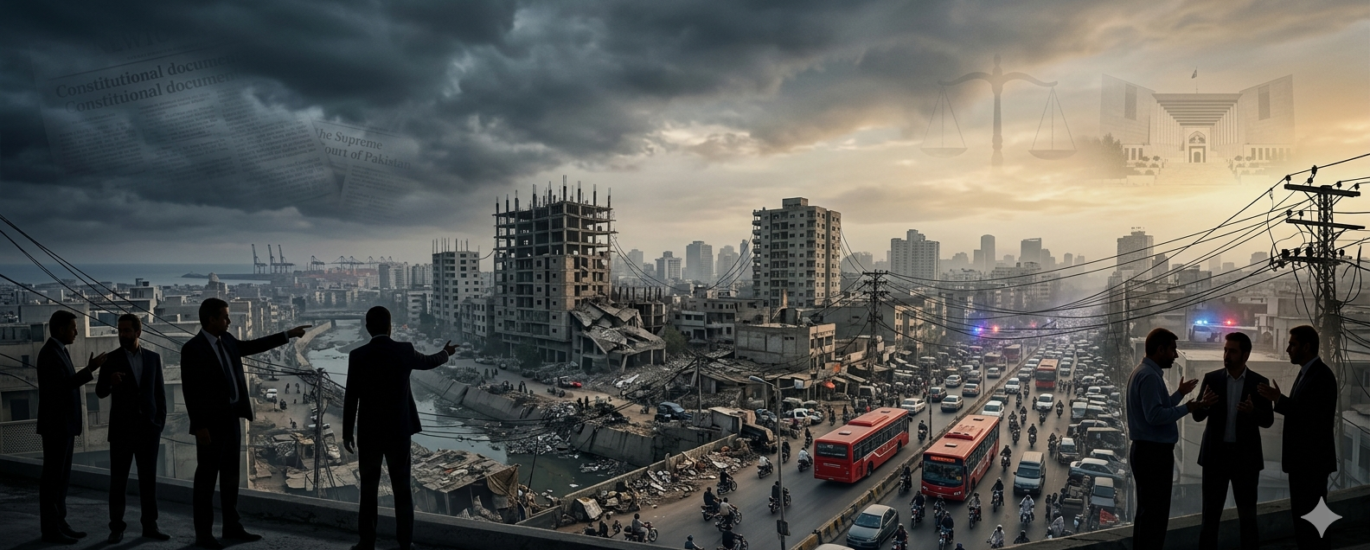
During the proceedings, the Supreme Court examined several categories of urban failures, including illegal encroachments, commercialization of amenity plots, occupation of pavements, illegal high-rise structures, and conversion of public spaces into commercial projects.
The hearings eventually led to scrutiny of major controversies including Nasla Tower, Tejori Heights, Gujjar Nullah, Orangi Nullah, and Mehmoodabad Nullah encroachments. The Court repeatedly observed that even state institutions themselves had become facilitators of illegal urban expansion and violations of planning laws.
These proceedings clearly established that Karachi’s urban crisis was not born overnight. The city’s administrative disorder accumulated over decades under multiple political arrangements, overlapping institutions, and inconsistent governance models.
Therefore, while criticism of the current Sindh government may contain legitimate concerns, reducing Karachi’s entire urban crisis solely to one political administration oversimplifies a deeply complex historical issue.
MQM’s Political Contradictions and the Politics of Bargaining
The present confrontation between MQM and PPP also exposes the contradictions within Karachi’s political dynamics. On one side, MQM harshly criticizes the Sindh government over governance failures, encroachments, and municipal administration.
On the other side, the same political leadership seeks political consensus with the government on constitutional matters, local government reforms, and financial packages for Karachi and Hyderabad.
This dual-track political strategy reflects the reality that MQM has historically remained one of the most significant beneficiaries of bargaining politics in Pakistan’s urban political framework. Politics itself often revolves around securing leverage, negotiating influence, and maximizing opportunities.
There is nothing unusual in political parties pursuing strategic advantages. However, continuous confrontation and excessively hostile rhetoric contribute to political instability rather than institutional solutions.
Karachi’s problems cannot be resolved through perpetual political warfare.
Governance, Development, and the Need for Balanced Political Discourse
Despite criticism, it would also be politically dishonest to entirely dismiss the development initiatives undertaken by the Sindh government in recent years. Projects such as the People’s Bus Service, Shahrah-e-Bhutto, road infrastructure expansions, and ongoing transport initiatives have received public acknowledgment and appreciation from many citizens.
Certainly, Karachi still requires significantly greater reforms, stronger municipal structures, transparent administration, and long-term urban planning.
No serious observer can deny that the city continues to face enormous challenges in waste management, drainage, water supply, transport integration, and housing regulation.
However, political discourse must also allow room for balanced acknowledgment alongside criticism. Constant confrontation without institutional cooperation only deepens polarization and creates further hurdles for governance and implementation.
Remembering Karachi’s Darkest Years
The current political climate also demands remembrance of Karachi’s darkest periods, particularly the Karachi Law and Order Suo Motu Case No. 16 of 2011 initiated by the Supreme Court under Chief Justice Iftikhar Muhammad Chaudhry.
The case emerged after Karachi witnessed one of its deadliest phases involving target killings, gang warfare, extortion rackets, political violence, and ethnic clashes. During proceedings, Rangers, intelligence agencies, police officials, and political representatives were summoned before the Court.
Serious allegations surfaced regarding armed wings linked to political and ethnic groups, while the Court repeatedly criticized the failure of the state machinery in restoring order.
The Supreme Court observed that Karachi had effectively developed “no-go areas,” policing had become politicized, and ethnic polarization had severely destabilized the city. The verdict ultimately directed authorities to depoliticize the police, dismantle armed wings, restore state authority, and eliminate extortion and target killings.
This case remains one of the clearest reminders that Karachi’s political instability once pushed the city dangerously close to institutional collapse.
Today’s political leadership across all parties must recognize that repeating the politics of confrontation, territorial polarization, and perpetual hostility risks reopening wounds that Karachi has struggled for decades to overcome.
Beyond Political Rivalry: The National Dimension
Political instability within Karachi does not remain confined to provincial politics alone. It directly affects national economic stability, investor confidence, social cohesion, and youth development.
At a time when Pakistan faces economic challenges, regional tensions, diplomatic pressures, and internal security concerns, continuous political polarization only weakens national institutional capacity.
Every political party recently stood united in acknowledging the strategic and diplomatic achievements of the country’s leadership on international fronts. Yet domestically, the same politicians remain trapped within cycles of confrontation and political point-scoring.
Even recent debates surrounding narcotics networks, youth vulnerability, and organized criminal activities in educational institutions demonstrate that Karachi still requires coordinated governance, not political fragmentation.
The city’s future cannot be secured through blame alone.
The Need for Political Maturity and Collective Responsibility
Karachi’s history teaches a painful lesson: when politics transforms into perpetual confrontation, institutions weaken, governance collapses, and ordinary citizens suffer the most.
The city does not need another era of political hostility built upon accusations and counter-accusations. Nor does it need selective accountability that ignores historical responsibility. Karachi requires administrative continuity, political maturity, institutional coordination, and democratic inclusion for every political force operating within constitutional boundaries.
Every political party, whether PPP, MQM, Jamaat-e-Islami, or any other stakeholder, has, at different times, either governed Karachi, influenced its administration, or shaped its political trajectory. Consequently, responsibility too remains collective.
The time has come for political leadership to move beyond tactical confrontation and focus on long-term governance reforms, urban planning, law enforcement, youth protection, and economic revival.
Karachi has already paid a heavy price for political division in the past.
The country cannot afford to repeat the same mistakes again.