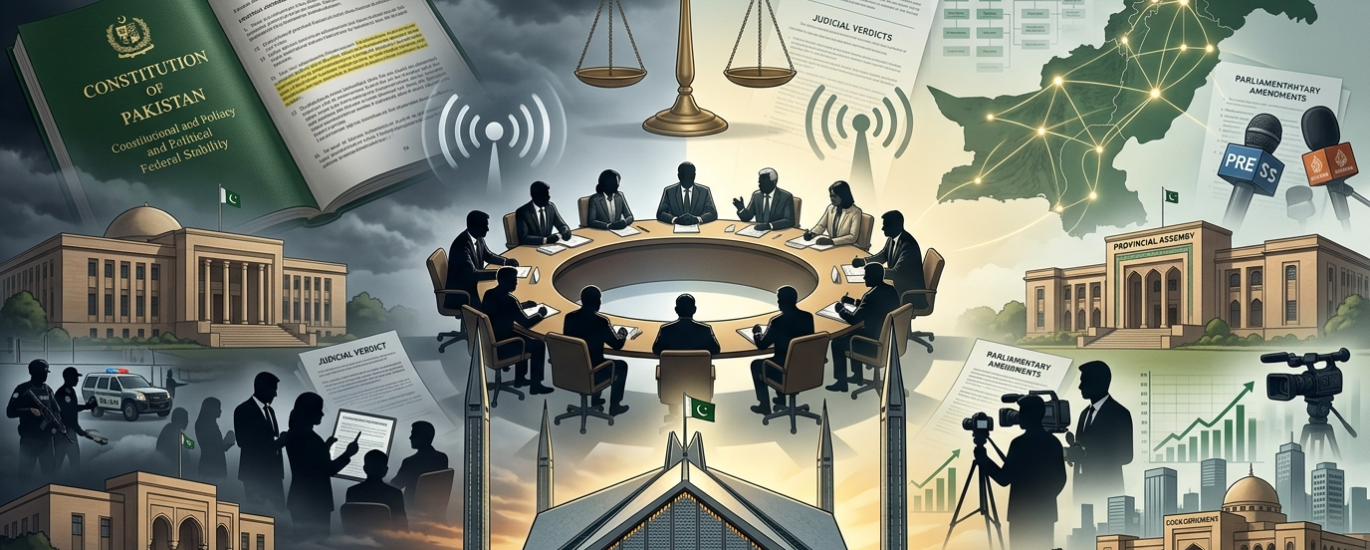
For decades, Pakistan’s constitutional and political structure has remained trapped between two competing interpretations of governance: one advocating maximum provincial autonomy in the name of democracy, and the other emphasizing a stronger federation in the name of national stability, economic coordination, and institutional cohesion. The debate surrounding a proposed “28th Amendment” emerges precisely from this unresolved constitutional tension.
At a time when Pakistan faces economic fragility, regional instability, political polarization, administrative fragmentation, and governance inconsistencies, the need for constitutional recalibration has become increasingly unavoidable. The proposed restructuring through the 28th Amendment is not merely a legal exercise; it represents an attempt to redefine the relationship between the federation, the provinces, political stakeholders, and state institutions in order to establish a more stable and coordinated national framework.
The essence of the debate is not whether provincial autonomy should exist. Provincial autonomy remains one of the most significant democratic achievements in Pakistan’s constitutional history. The real question is whether the existing constitutional structure has created sufficient legal clarity, administrative coordination, and national cohesion to ensure effective governance throughout the country.
Civil-Military Relations and National Stability
One of the most important realities shaping Pakistan’s present political environment is the restoration of comparatively stable civil-military relations. History repeatedly demonstrates that whenever civilian governments and state institutions move in conflicting directions, the country suffers from economic uncertainty, political instability, weakened governance, and diplomatic isolation. Conversely, when institutional harmony prevails, investor confidence improves, policymaking becomes coherent, and the state projects stability internationally.
In this regard, the current phase of civil-military coordination is being viewed by many observers as a critical opportunity for national reconstruction. Strong institutional coordination has not only enhanced Pakistan’s strategic posture but has also contributed to greater diplomatic engagement and border management.
It is equally important to acknowledge the role of Asim Munir for his diplomatic outreach, strategic positioning, and border-related achievements during an exceptionally sensitive regional environment. Supporters of the present institutional framework argue that the country’s relative internal stabilization, improved international engagement, and enhanced security coordination reflect the importance of constructive civil-military understanding rather than institutional confrontation.
Pakistan’s political history, unfortunately, contains several phases where hostility between politicians and state institutions damaged democratic continuity itself. The era following the Panama proceedings and the subsequent political turmoil became a symbol of deep institutional confrontation. Political speeches, judicial tensions, accountability disputes, and public campaigns against institutions collectively produced an atmosphere of uncertainty that weakened governance and polarized the state.
Today, however, the same political forces increasingly appear to recognize that prolonged confrontation with institutions neither benefits democracy nor strengthens political legitimacy. The emerging emphasis on national dialogue reflects a gradual realization that reconciliation, coordination, and constitutional consensus may serve Pakistan far better than perpetual political warfare.
Why National Dialogue Has Become Essential
The proposed national dialogue is not simply a political arrangement between rival parties. It is increasingly being viewed as a necessity for long-term political continuity and constitutional stability.
Pakistan’s political system has repeatedly suffered because governments spent more energy dismantling opponents than strengthening governance. Every major political party — whether the Pakistan Muslim League (N), Pakistan Peoples Party, or Pakistan Tehreek-e-Insaf — has, at different times, contributed to the cycle of political victimization, institutional confrontation, and destabilization.
The proposed national dialogue offers a rare opportunity to reverse this pattern.
For the ruling coalition, political consensus can ensure governmental continuity, economic predictability, and reduced institutional friction. For opposition forces, particularly PTI, the dialogue represents an opportunity to politically rehabilitate itself, regain democratic credibility, and re-enter mainstream parliamentary engagement with renewed legitimacy.
More importantly, the dialogue may gradually reduce the politics of institutional confrontation that has repeatedly damaged democratic structures. Instead of treating political opponents as existential enemies, the major stakeholders may finally move toward coexistence within a constitutional framework.
The success of such a dialogue could establish an environment where political parties govern their respective provinces with greater administrative clarity and reduced institutional conflict, while simultaneously remaining aligned with broader national priorities established through the federation.
The Constitutional Debate: 18th Amendment and Its Limitations
The Eighteenth Amendment to the Constitution of Pakistan remains one of the most transformative constitutional developments in Pakistan’s democratic history. It substantially expanded provincial autonomy by devolving numerous ministries and powers from the federation to the provinces.
There is little dispute that the amendment empowered federating units politically and constitutionally. However, over time, several constitutional ambiguities, jurisdictional conflicts, and governance limitations emerged regarding administrative coordination, taxation authority, regulatory overlap, health governance, and national policymaking.
Critics of the post-18th Amendment framework argue that while powers were devolved, the legal and institutional mechanisms required for effective coordination between the federation and provinces remained incomplete. As a result, confusion emerged over territorial discretion, fiscal jurisdiction, and executive authority.
Beyond the broader constitutional and fiscal debate, the proposed 28th Amendment also creates an opportunity to initiate long-overdue provincial constitutional reforms concerning anti-narcotics operations, law and order management, local government empowerment, and media governance. Pakistan’s internal stability cannot be achieved solely through economic coordination between the federation and provinces; it equally depends upon the state’s ability to ensure administrative transparency, public security, institutional accountability, and democratic inclusiveness at every level of governance. The growing narcotics crisis, urban criminality, administrative fragmentation, and weak local government structures continue to expose serious governance gaps within the provinces. Therefore, constitutional recalibration must also focus on strengthening coordinated anti-narcotics frameworks, modernizing policing structures, empowering local government institutions, and clarifying federal-provincial administrative responsibilities to ensure effective governance and public trust.
This constitutional uncertainty became evident in several landmark Supreme Court decisions.
Sindh Revenue Board v. Civil Aviation Authority
In the case concerning the Sindh Sales Tax on Services imposed upon the Civil Aviation Authority, the Supreme Court observed that aviation operations inherently involve national connectivity and inter-provincial coordination. The Court reasoned that allowing provinces to independently impose taxation on such federally connected operations could complicate national aviation systems, increase operational costs, weaken national cohesion, and adversely impact remote regions dependent on subsidized connectivity.
The Court ultimately held that the Sindh Sales Tax on Services Act, 2011, to the extent that it imposed taxation on the Civil Aviation Authority, was unconstitutional and void ab initio. The verdict reflected the broader constitutional dilemma created when provincial autonomy intersects with matters carrying national implications.
Government of Sindh v. Dr. Nadeem Rizvi
Another critical judgment emerged regarding institutions such as Jinnah Postgraduate Medical Centre (JPMC), NICVD, NICH, and other federally linked entities transferred to provincial control after the 18th Amendment.
The Supreme Court declared those transfers unconstitutional due to procedural irregularities and a failure to properly interpret the constitutional intent of the 18th Amendment. The judgment reaffirmed that the federation retains authority to undertake projects and maintain institutions that serve national purposes, even while provinces continue exercising regulatory and executive functions within their territorial limits.
These verdicts collectively demonstrate that constitutional ambiguities still exist regarding the balance between provincial autonomy and federal coordination.
The 26th and 27th Amendments: Rebalancing Federalism
Supporters of the proposed 28th Amendment argue that the Twenty-sixth Amendment to the Constitution of Pakistan and Twenty-seventh Amendment to the Constitution of Pakistan already initiated a gradual reassertion of federal authority and institutional accountability mechanisms.
These amendments are viewed by some constitutional observers as efforts to rebalance governance after the sweeping decentralization introduced by the 18th Amendment. Critics, however, contend that they weakened judicial independence and reduced constitutional protections.
The debate ultimately reflects a larger constitutional struggle: how to preserve democratic provincial autonomy while simultaneously ensuring national policy coherence, economic stability, institutional accountability, and administrative uniformity.
The proposed 28th Amendment appears intended to continue this rebalancing process.
Restructuring the National Finance Commission
Perhaps the most sensitive aspect of the proposed amendment concerns the restructuring of the National Finance Commission (NFC) Award.
The NFC Award remains the backbone of Pakistan’s fiscal federalism. Following the 18th Amendment, constitutional clauses ensured that provinces could not receive a share lower than previous allocations, while financial monitoring responsibilities were expanded through coordinated reporting mechanisms involving both federal and provincial finance ministers.
However, the federation increasingly argues that economic realities, debt obligations, national security expenditures, healthcare coordination, and education reforms require stronger federal fiscal capacity.
This explains why proposals regarding the federation’s expanded role in health, education, and financial coordination remain politically controversial.
The Pakistan Peoples Party appears cautious regarding NFC restructuring because provincial financial autonomy forms a central component of its political identity, particularly in Sindh. Nevertheless, many analysts believe ongoing disagreements may ultimately evolve into negotiated adjustments rather than outright constitutional confrontation.
Political Beneficiaries of the 28th Amendment
If a successful national dialogue materializes alongside constitutional restructuring, the political beneficiaries could be substantial.
The Pakistan Muslim League (N) would likely benefit from enhanced governmental continuity and a stronger federal structure. The Pakistan Tehreek-e-Insaf may gain an opportunity for political reintegration and institutional normalization after years of confrontation. Meanwhile, the Pakistan Peoples Party could secure long-term provincial authority while simultaneously retaining influence within the federal structure.
There is also growing political speculation surrounding Bilawal Bhutto Zardari and his future national role. Many within political circles believe that a successful consensus model may eventually pave the way for him to emerge as a future Prime Minister under a broader reconciliatory political arrangement.
Simultaneously, internal provincial political dynamics within the PPP continue evolving. The increasing visibility of Syed Nasir Hussain Shah in inter-party negotiations and provincial coordination is being interpreted by some observers as an indication of changing organizational alignments within the party’s Sindh structure.
At the same time, evolving political developments continue to generate speculation regarding the future direction of provincial politics within the Pakistan Peoples Party. In particular, questions are increasingly being raised regarding the political significance of Faryal Talpur potentially contesting elections in Azad Jammu and Kashmir. Political observers remain divided on whether such a move represents a strategic political diversion intended to shift attention away from ongoing provincial political affairs and internal organizational dynamics, or whether it signals preparations for a broader long-term political restructuring within the party and the national political landscape itself. Regardless of interpretation, the development reflects the larger political reality that Pakistan’s constitutional and political transition is no longer confined solely to legislative amendments, but is increasingly connected to wider questions of political succession, institutional alignment, and future power configurations across the federation.
Burying the Politics of Confrontation
Pakistan’s greatest political failures often emerged not from constitutional weakness alone, but from the refusal of politicians to coexist within constitutional boundaries.
The confrontational politics witnessed during the Panama era, institutional conflicts, contempt proceedings, and hostile public rhetoric collectively weakened democratic continuity and governance itself. Political parties that once accused institutions of engineering political outcomes now increasingly recognize that national stability cannot emerge from perpetual institutional warfare.
The evolving discourse surrounding the 28th Amendment, therefore, symbolizes something larger than constitutional reform. It reflects an attempt to bury the politics of confrontation and replace it with political coexistence, negotiated federalism, and institutional coordination.
The proposed amendment may not satisfy every stakeholder entirely. Constitutional restructuring rarely does. However, if pursued through genuine consultation, national dialogue, parliamentary consensus, and democratic negotiation, it could become an opportunity to modernize Pakistan’s federal structure while preserving democratic continuity.
Ultimately, the success of any constitutional amendment will not depend solely upon legal drafting. It will depend upon whether Pakistan’s political leadership, institutions, and stakeholders finally choose stability over confrontation, consensus over polarization, and national cohesion over perpetual political conflict.
Simultaneously, the question of media legislation deserves serious national consideration within the framework of institutional reforms and political reconciliation. Over the years, successive governments and political rivals have repeatedly amended controversial media laws, regulatory frameworks, and administrative mechanisms according to their political interests, often resulting in restrictions on journalistic independence and pressure upon the media fraternity. In periods of political confrontation, media institutions and journalists frequently became collateral victims of political rivalries, censorship pressures, regulatory misuse, and institutional conflicts. However, if the proposed national dialogue genuinely succeeds in creating political consensus and reducing confrontational politics, then there should no longer remain space for political actors to weaponize media regulations against opponents or critical voices. In this spirit, it becomes essential for the state to revisit and reform the legal structures governing federal and provincial information ministries, media regulatory authorities, commissions, press associations, and related institutional frameworks to ensure transparency, professional independence, and equal opportunities for journalists and media workers across the country. Like every citizen, Pakistan’s media fraternity also seeks the basic constitutional right to live, work, and grow peacefully within a stable democratic environment free from political victimization and institutional uncertainty.