
Politics is often described as the art of collective responsibility. In parliamentary democracies, especially in politically sensitive provinces like Sindh, political stability is not merely measured by electoral victories or numerical strength inside assemblies; it is equally judged through discipline, mutual respect, institutional dignity, and the maturity of political leadership. When internal acrimonies begin surfacing publicly, the damage extends far beyond party corridors. It weakens governance, confuses supporters, empowers opposition narratives, and gradually erodes public confidence in democratic institutions themselves.
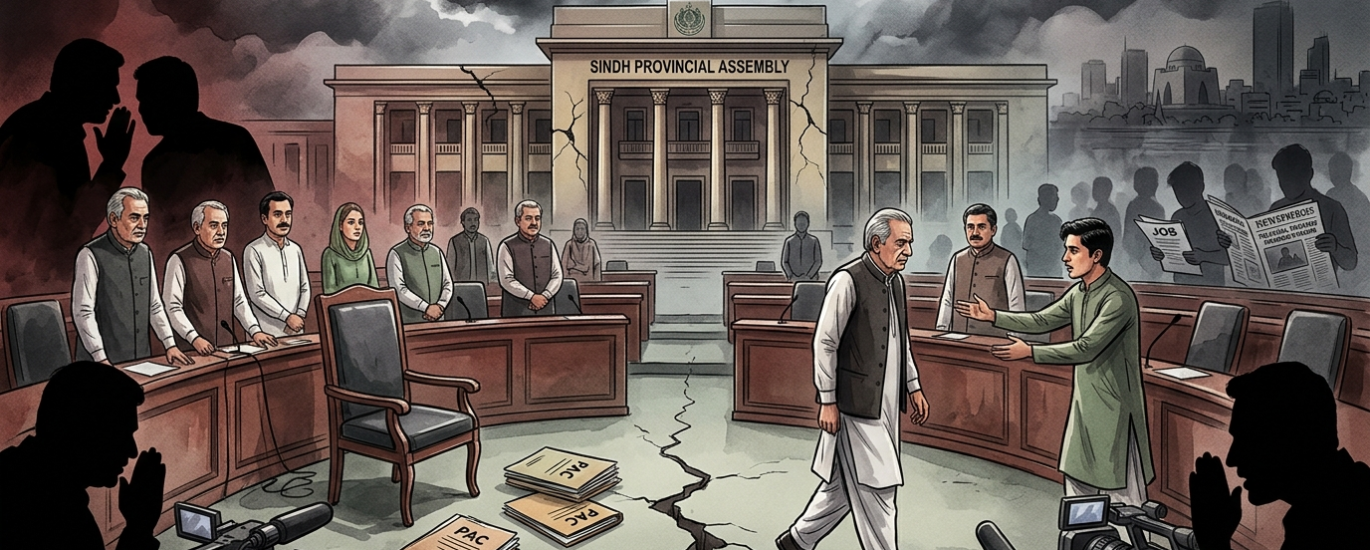
What unfolded in the Provincial Assembly on the 12th of May reflected far more than a routine disagreement over administrative matters. It exposed the growing polarization and hidden acrimony within the ruling political structure of Sindh. The controversy surrounding the appointment of the Secretary of the Public Accounts Committee (PAC), followed by the visible displeasure of the Provincial President of the ruling party, carried symbolic weight because it involved personalities who once stood at the center of parliamentary authority itself.
The image of a Provincial President walking out of the very assembly he once ruled as the custodian of the House sends a deeply concerning political message. This was not an ordinary parliamentarian expressing frustration. This involved a senior figure whose stature within the party and the parliamentary framework has historically commanded influence and respect. When such a figure publicly displays dissatisfaction, observers naturally begin questioning whether the issue is administrative, political, or the result of calculated internal isolation.
What made the events even more politically striking was the silence from the governing benches. Ironically, on one side, it was member from the opposition who appeared more vocal in defending parliamentary decorum and the dignity of the Speaker’s office. While on the other side, many considered close associates of the Provincial President remained noticeably absent from the defense. In politics, silence often speaks louder than words. The lack of open support created an impression that the senior leadership within the provincial wing is increasingly fragmented into camps, calculations, and survival strategies.
Amid this tense atmosphere, it was Zia Hassan Lanjar, a comparatively newer cabinet member, who stood up and requested that the interference of the opposition member be expunged from the record. His intervention may appear procedural on the surface, but politically, it carried significance. At moments when seasoned political allies remained hesitant, a relatively newer face chose institutional defense over strategic silence.
The question now emerging across political and media circles is whether the Provincial President’s reaction was a spontaneous emotional response, a pressure tactic aimed at reconciliation, or the consequence of sustained political marginalization from within his own ranks. Some view it as an indirect attempt by the party leadership to force a surrender or eventual resignation. Others believe it is a temporary political standstill designed to compel intervention from the higher leadership before matters deteriorate further.
Yet, despite visible dissatisfaction, the Provincial President refrained from publicly speaking against the Speaker while addressing the media. That restraint is politically important. In today’s hyper-polarized political climate, where internal disagreements often escalate into media wars overnight, his refusal to attack the institution or its leadership suggests that the matter may still be recoverable through political wisdom and intervention from the top.
Unfortunately, this is not an inaccessible incident. The broader political environment within the ruling structure of Sindh increasingly reflects a culture of internal rivalry, factional maneuvering, and silent power struggles. Public statements may continue insisting that “everything is under control,” but political observers, party workers, and journalists are fully aware that serious internal rifts persist beneath the surface.
As Sr. Journalist Rafiq Bhutto expressed the evolved political culture & stated, “Political divisions and the normalization of corruption have deeply damaged our democratic culture. I still remember when entering public life with integrity was considered a matter of honor, and corruption was viewed as a stain on political character. Today, many treat kickbacks and personal gains as part of political survival. This decline in political values has weakened public trust, distorted democratic ethics, and created an unhealthy environment for meaningful and principled politics in our country.”
One of the most discussed tensions remains the reported political disagreement between Sharjeel Inam Memon and Jam Khan Shoro. Despite repeated public assertions that the party leadership remains united, the political atmosphere suggests otherwise. The matter reportedly awaits resolution from higher authorities, indicating that provincial-level reconciliation mechanisms may already be insufficient to contain the differences.
Similarly, the allegations publicly raised by Nasir Kareem created additional discomfort for the party. Whether those allegations are ultimately proven or not is a legal and evidentiary matter. However, politically, allegations themselves can inflict damage when they raise questions about institutional credibility, internal accountability, and administrative transparency. In democratic politics, perception often travels faster than proof.
The situation becomes even more concerning when these internal divisions begin appearing in politically symbolic regions like Larkana, the hometown associated with the Bhutto political legacy. The reported acrimony between Sohail Anwar Siyal and Jameel Soomro reflects how factional politics is no longer confined to peripheral districts but has now touched even the ideological and emotional heartland of the party itself.
Beyond political rivalries, the province also confronts the growing public debate surrounding narcotics and organized criminal networks. The crackdown initiated under the directives of the provincial leadership has undoubtedly produced visible operational results. Law enforcement agencies deserve acknowledgment for pursuing dangerous criminal elements and attempting to dismantle narcotics networks that have devastated countless families.
However, politics operates not only through state action but through public trust. Here, difficult questions emerge. The public inevitably asks how influential political and social circles failed to protect even their own children from the menace of drugs while simultaneously expecting ordinary citizens to fully trust institutional narratives. The media coverage following the apprehension of the alleged drug network figure known as “Anmol alias Pinky” intensified these concerns and amplified public skepticism.
Respect for the police institution remains essential because law enforcement officers often place themselves in harm’s way to maintain public order. Yet, the criticism surrounding the protocols and treatment witnessed during procedural court appearances in this particular case created damaging optics. Democratic societies demand not only justice, but also the visible appearance of equal accountability. Any perception of preferential treatment damages public confidence and undermines the credibility of otherwise commendable anti-narcotics efforts.
At this stage, the political crisis in Sindh increasingly appears beyond the capacity of routine statements and temporary damage control. This is now fundamentally a leadership issue requiring direct intervention from the highest levels of the party structure. The influence and authority exercised by the senior stateswoman of the party over provincial political matters is widely acknowledged across Sindh’s political landscape. If reconciliation is still possible, it may require her direct involvement.
The concern is no longer limited to individual disagreements. The larger issue is the emergence of a political culture where seniority appears increasingly disregarded, institutional respect weakened, and internal dialogue replaced by silent political positioning. When senior leaders feel isolated, when influential camps operate independently, and when political workers begin observing humiliation rather than cohesion, organizational morale inevitably declines.
This becomes particularly dangerous at a time when youth voters are emerging as the decisive political demographic. Younger generations are observing everything closely — not only governance performance but also political behavior, institutional maturity, and leadership ethics. They are witnessing internal disorder at a time when they expect economic relief, employment opportunities, educational reforms, and stable governance. Political parties cannot expect unwavering loyalty from a generation increasingly influenced by transparency, merit, and accountability.
While Bilawal Bhutto Zardari and Asif Ali Zardari remain occupied with national political responsibilities, someone from the top leadership structure must intervene decisively within the provincial framework before internal divisions evolve into irreversible breakages. Political history repeatedly demonstrates that parties rarely collapse solely because of opposition pressure; they weaken when internal conflicts remain unresolved for too long.
The Chief Minister may continue managing administrative governance, but political reconciliation requires moral authority and organizational influence that ordinary administrative structures often cannot enforce. Political disputes cannot always be resolved through procedural meetings or public denials. Sometimes they require direct intervention, sincere dialogue, and the willingness to prioritize collective survival over temporary factional advantage.
The ruling party in Sindh must now decide whether it wishes to preserve long-term political relevance or continue tolerating internal polarization for short-term tactical convenience. Politics built entirely around camps, isolation, and controlled silence eventually begins consuming its own foundations.
Sindh’s political future deserves stability, institutional dignity, and mature leadership. Internal acrimony may temporarily benefit individuals, but prolonged division risks damaging the collective political legacy built over decades. If reconciliation does not arrive in time, today’s hidden acrimonies may eventually become tomorrow’s irreversible political decline.
The choice now rests with the leadership — because in politics, unresolved silence often becomes the loudest warning before collapse.