
In every democratic society, the hopes of the youth are directly tied to the credibility of public institutions. Young people do not merely seek employment; they seek dignity, recognition, and equal opportunity. When institutions designed to uphold merit begin to face allegations of political influence, favoritism, and nepotism, the consequences extend far beyond recruitment controversies. Such developments gradually erode public trust in governance itself.
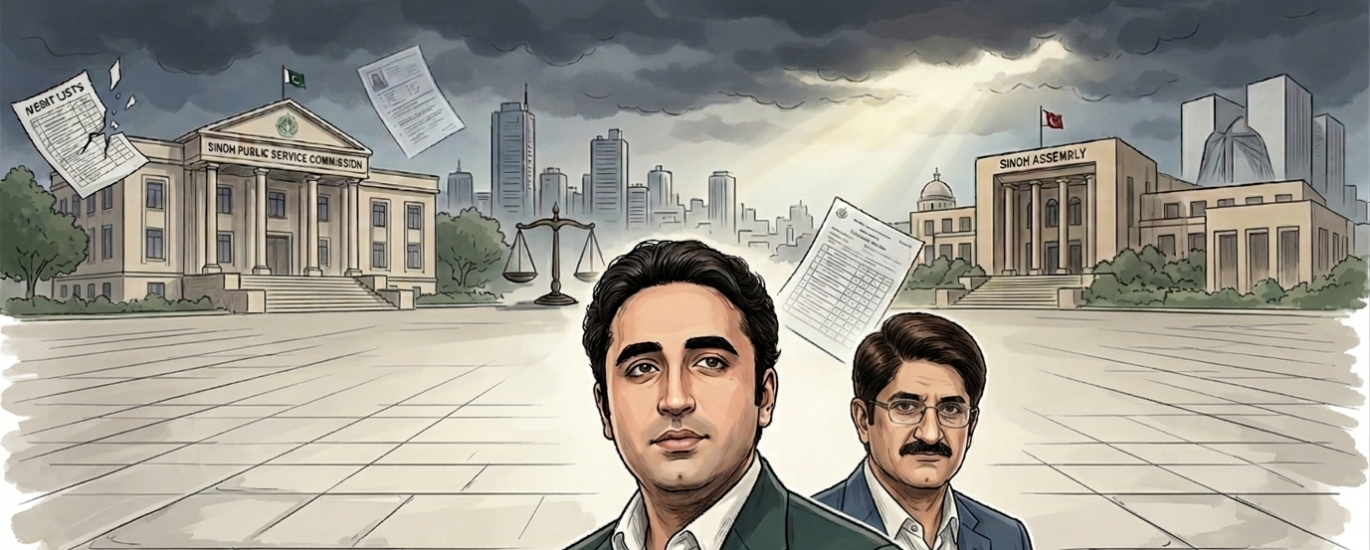
The recent concerns surrounding the alleged non-merit recruitments through the Sindh Public Service Commission have once again reignited a critical debate in Sindh: whether competitive examinations genuinely reward merit, or whether political influence continues to overshadow deserving candidates.
This issue arrives at a politically sensitive moment. The largest voter bloc in the upcoming elections is undoubtedly the youth. These young citizens are educated, digitally connected, politically aware, and increasingly vocal about unemployment and institutional injustice. They expect opportunities, not symbolic gestures. They seek transparency, not selective favoritism.
It is important to recall that only last year, the provincial government attempted to present itself as youth-oriented through innovative employment initiatives. One such initiative was the I Work For Sindh portal, inaugurated with considerable enthusiasm. The project carried promise. It reflected an acknowledgment that unemployment among the youth could no longer be ignored. The Senior Minister for Information & Transport himself signed several Memorandums of Understanding with commercial and industrial entities to expand job listings and encourage private-sector opportunities.
On paper, it was a commendable initiative.
However, a painful contradiction now emerges before the public. On one hand, the government launches employment portals and speaks the language of opportunity. On the other hand, allegations surrounding the competitive examinations suggest that influential connections continue to determine outcomes for many candidates. This contradiction damages not only the credibility of institutions but also the emotional confidence of an entire generation.
The tragedy of nepotism is not merely that one undeserving candidate succeeds; it is that hundreds of deserving individuals begin to lose faith in the system altogether.
One must also acknowledge that peaceful protest remains a constitutional and democratic right. Citizens who believe they have been wronged possess every moral and democratic justification to raise their voices. In this regard, the complaint reportedly lodged against peaceful protesters by the Sindh Public Service Commission deserves condemnation. Democracies do not silence dissent; they engage with it. Institutions should respond to allegations through transparency and inquiry rather than confrontation against candidates demanding accountability.
The government must understand that suppressing peaceful criticism only amplifies public suspicion.
This crisis also reveals another uncomfortable reality: the shrinking independence of the media industry. Whenever journalists, analysts, or media workers attempt to highlight governance failures or alleged injustices, direct and indirect pressure often follows. Unfortunately, the issue is no longer about the “rule of law”; increasingly, critics argue that it reflects “rule by law” — where legal instruments are selectively used to discourage criticism rather than ensure justice.
The media industry itself is struggling for survival. Economic instability has pushed many outlets into dependence upon government advertisements and official revenue streams. This dependency weakens editorial independence and creates an environment where difficult questions become financially risky.
The irony is particularly painful because promises were repeatedly made to media workers regarding minimum wages and labor protections. Even the provincial Senior Minister for Information reportedly attempted to push for implementation of minimum wage commitments for journalists and media workers. Yet, according to sources within the industry, resistance emerged primarily from media outlet owners, who argued that without sustainable governmental support and operational assurances, they could not fulfill the salary structures desired by the provincial government.
This reflects a deeper structural crisis in Pakistani media: owners demand financial stability, workers demand dignity, and governments demand favorable narratives. Caught in the middle are journalists struggling to survive while still attempting to uphold professional integrity.
It is worth acknowledging that Shazia Marri, former provincial Information Minister and current Member of the National Assembly, reportedly urged the Federal Information Minister and the Speaker of the National Assembly to hear the demands of media workers and address their grievances. Such interventions indicate that concerns surrounding media workers are neither isolated nor imaginary.
Yet, despite these efforts, frustration continues to grow.
Simultaneously, political tensions within influential constituencies have intensified. The Senior Minister and his son themselves reportedly face political backlash within their own region, and the ongoing conflict has deeply affected both families politically. The matter, however, is still believed to be pending before the party’s top leadership.
These internal conflicts reveal how political instability eventually spills into governance, administration, and public confidence.
At the recent Labour Day event, the provincial Labour & Human Resources Minister passionately declared that his party would never support laws that snatch away the rights of labourers and workers. It was a powerful statement. However, many young candidates today ask a painful question: if workers deserve protection from exploitation, do deserving candidates not deserve protection from injustice in public recruitment?
After all, the denial of fair opportunity is also the denial of livelihood.
Some political circles have attempted to soften public criticism by recalling that even the son of the Local Government Minister reportedly failed in the competitive examination process. While such examples may demonstrate that influence does not guarantee success in every case, they cannot be used to dismiss broader concerns surrounding alleged irregularities. Public confidence cannot be restored through isolated anecdotes; it requires transparent investigation and institutional accountability.
At this point, it becomes equally important to remember the historically cordial relationship between journalists and the Chief Minister. Senior journalist Fazil Jamili once narrated an occurrence regarding the financial grant for the Karachi Press Club. According to Jamili, journalists had requested an increase in operational funding due to inflation and rising costs. The Chief Minister reportedly assured them that the matter would be evaluated. Later, during another event at the Chief Minister’s House, Jamili contacted the Chief Minister to follow up on the request, only to be informed that the existing grant for the Karachi Press Club had already been doubled.
Such stories matter because they portray a Chief Minister who has historically maintained goodwill with journalists and media institutions. Indeed, the current Chief Minister is widely regarded as educated, politically experienced, and shaped by a strong political legacy. Despite criticism and controversies, many acknowledge that he worked diligently to rise to his current position.
However, leadership is ultimately tested not during moments of praise but during moments of crisis.
Today, media workers, students, civil society voices, and competitive examination candidates are collectively demanding transparency, inquiry, and justice regarding the alleged non-merit recruitments in the Sindh Public Service Commission. The demand is no longer political; it has become institutional and moral.
Senior journalist Rafiq Bhutto has already appealed to Bilawal Bhutto Zardari to personally intervene and help resolve the controversy. Such appeals carry political significance because the candidates appearing in these competitive examinations are not disconnected observers — they are educated young voters, many of whom once viewed the ruling party and its youthful chairman as symbols of progressive politics and opportunity.
Ignoring their concerns would carry long-term political consequences.
Meanwhile, discussions surrounding the future leadership of the Sindh Public Service Commission continue to circulate within political and bureaucratic circles, particularly as the current chairman’s service tenure reportedly approaches its conclusion. Among the names being discussed are former Inspector General of Police Ghulam Nabi Memon and renowned Bureaucrat Gufran Memon.
Yet, regardless of who assumes future leadership, the core question remains unchanged: can public institutions restore the confidence of the youth?
This controversy is not merely about examination papers, interview panels, or recruitment lists. It is about the future relationship between the state and its educated young citizens. Democracies survive when merit is protected, criticism is tolerated, and institutions remain stronger than political interests.
Sindh’s youth are not demanding miracles. They are demanding fairness.
And in a democracy, fairness should never be treated as rebellion.