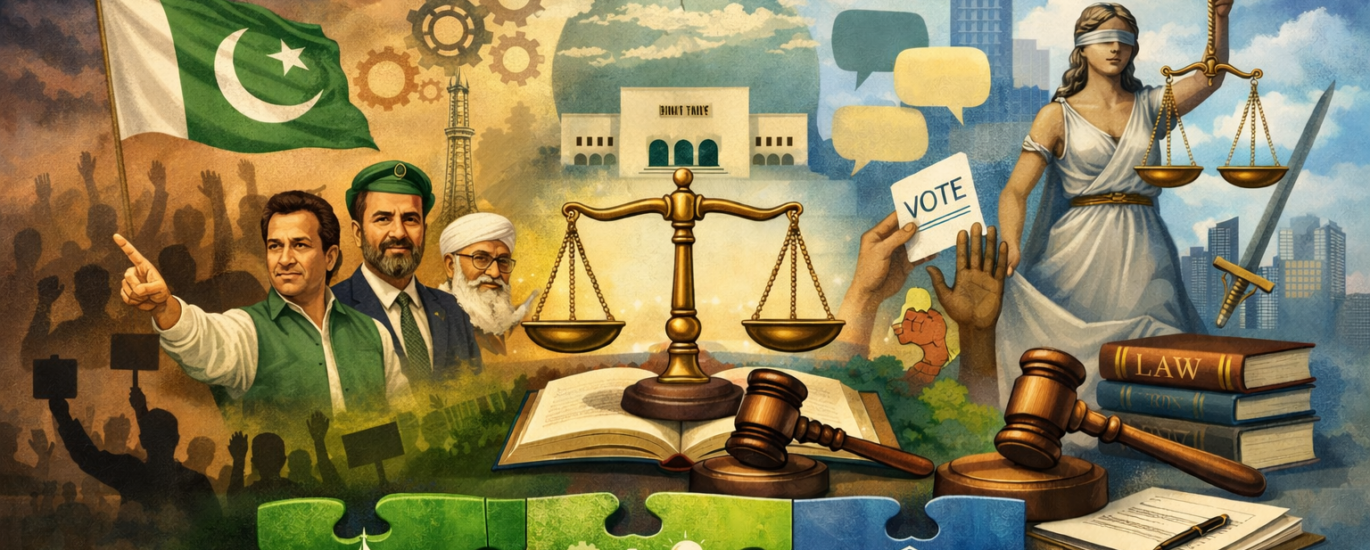
We have been hearing a rhetoric of justice & injustice by the people who believed in democracy. Despite knowing that the democracy has given us nothing but the liberty to manipulate & misuse the authority in the name of public interest. However, the political interests or government interest is connected with the public interest, especially when it comes to the amendment of laws that eventually benefit the systematic dodging & snatching away of the rights. Every controversial law has diversified perspectives; it is either directly or indirectly connected with certain political, institutional gains, and that is where the question arises whether it benefits the public or not.
Unfortunately, in our country, the people are divided in every aspect, whether it’s political, ethnic, caste, or creed. Similarly, the law for the same people is divided into three different forms. One that represents the Shariah law for the people who believe in Islamic laws, the second is the constitutional law of Pakistan that represents the majority of the people, whereas the third law represents the Jirga, Sardari, or head of the tribe laws for the people of rural areas.
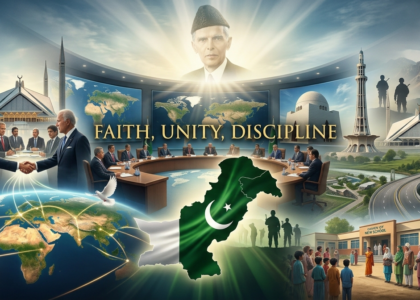
Today, where the Pakistan has stepped forward and broken the stereotype patterns of diplomatic strategy with the collaborative efforts of military & civil leadership. Nonetheless, every single Pakistani national must be proud of that feeling that came with the victorious wins on the borders & regaining the lost sanctity of a country’s flag. From statements like “Beggars can’t be choosers” to the “Mediators of global Wars” we have achieved something which I believe could have been impossible if the country’s leadership had continued the same rhetoric or acrimony with the armed forces leadership. Nobody can deny that we have achieved this milestone due to the prosperous civil-military relations. In Addition, Sindh is witnessing a missing factor. As they say, “Ace of Spades”, I mean, President Asif Ali Zardari in Iran-US peace talks. With respect & love towards the armed forces, I believe the President’s presence in Iran could have been a game-changer in a context that PPP and Iran’s leadership’s relations have been prosperous from Z.A Bhutto to Bilawal Bhutto Zardari. In a mediation, trust & relations serve as an edge.
In continuation of notions over the past achievements, a government should also think of amending the laws accordingly. The different perspectives & resistance will always be there to face, but the reforms will allow an upcoming generation to breathe in this unjustified systematic misuse of powers. Every section of society requires this to flourish, including the Judicial system, Policing, Media, and Politics.
Undoubtedly, People often refrain from suggesting the judiciary merely because they believe that the judiciary’s integrity is the topmost priority. It is the only institution where people believe justice will be delivered. However, the judge judges on the basis of available evidence. In some cases, acquittance is justified due to a lack of evidence. Just like politics, there’s no place for emotions when it comes to a verdict. Whereas, sometimes the Law vs Justice theory questions the entire ruling that portrays that the law prevails, but justice is denied. For instance, we have the recent example of the famous Um-e-Rubab Chandio’s verdict. The only mistake she made was that she allegedly dragged several innocents into the First Investigation Report of his father’s murder. Not to offend, but to understand the difference between Law & Justice, I must include a testimony that reflects the injustice of an individual who defamed the judiciary. To understand in depth, I will quote a speech of President Zardari during a meeting with the Supreme Court Bar Association (SCBA) in August 2012 amid tensions, as written in the President’s biography “The Zardari Presidency” by his former spokesperson, Farhatullah Babar. It says “With anguish, he (President) recalled some instances. “When I was given bail in the narcotics case, I was still kept in jail in the BMW car case. This Chaudhary calls himself courageous and independent. It was the same Iftikhar Chaudhary who, at that time dared not give me bail, saying every time that he had yet to study the case, but when we successfully negotiated the return to democracy, he readily granted me bail. A BMW car was not registered in my name, but I, the President, was kept in jail for two years for it. Still, I did not take it as a personal affront. If I have to be in politics for larger objectives, I have to take such injustices in my stride. There’s no complaint or grudge against any judge on this score”.
I am not a political worker of any political wing, but yes! I am a student of politics, and some of the political leaders inspire us, so we read, quote, and sometimes glorify their words.
In Policing, we have often heard the allegations of corruption, misuse of power, and abductions. The Provincial Home Minister was also accused of misusing his powers and settling scores with his political rivals several times. However, the other perspective portrays that under his tenure as a Minister, things have positively changed in terms of the police behavior, and the controversies have reduced. In Addition, the Provincial Home Minister also belongs to the law fraternity and holds a Law & Parliamentary Affairs portfolio, which is a complete political discourse itself in terms of the role he single-handedly can play in amending certain controversial laws for the benefit of society. Recently, A DIGP Pir M. Shah was accused of the same severe charges. He was transferred and reinstated in just a month. However, approximately 188 cases are filed against several Police officials, from SP to IGP ranks, from the 1990s to date. In my view, looking at his policing career and reputation, Pir M. Shah was trapped in this particular case. He has been known for his policing of traditional pattern breakers as the SSP. Nominated for the IGP Sindh appointment by the Sindh government after his successful E-Challan & technical integrated safety cameras in Karachi assignment. Looking at the media trial he faced, and some of our respective colleagues have been witnessed getting personnel by defaming him. My Perspective differs from the media reports on the basis of the legal notice that was sent by Pir M. Shah and his wife. Allegations of extra-marital affairs are a very personal issue, and the media should refrain from highlighting the personal matters. However, a married man will understand that a wife will never defend her husband in extramarital affairs. In my view, he deserves an apology for these particular extra-marital affairs accusations. Furthermore, other charges against a policeman are not new, and it is a judicial matter. The honorable courts will decide whether he is guilty or not. If we look at the career of the current IGP, his field experience, intelligence-led operation skills, in-depth information on criminal networks, and a clean background serve as an edge for the IGP. I believe if IGP he reinstated one of his officers, then I believe the evidence in the Pir M. Shah case is weak.
In an evolving landscape of media, the leaders of the journalistic fraternity & Federal or Provincial Minister of Information must acknowledge and transform the policies accordingly. As a student, I understand that the change is not easy. Resistance from several individuals is also difficult for the leaders to face. However, it is also necessary to transform & subtle shift the policies before it’s too late. I will recall a conversation with two senior journalists, Fazil Jamili & Rafiq Bhutto, on the PECA subject. The seniors showed their desire to demand freedom of expression for everyone, not just journalists. However, I differ with their opinion because a common person will not be able to bear the consequences of confronting the state institutions, political narratives, and the state’s bureaucratic machinery. A journalist has to pay the price for every word he writes or says on camera. I will also include an unofficial statement of DGPR Karachi, Iram Tanveer, which portrays that the state machinery is also intending to change certain things. In a conversation regarding the questions raised by the youth and the ongoing challenges during her service, she replied, “It’s not just about service, it’s about being willing to contribute and change, and that is why she herself attends the seminars and conferences to interact with the youth. To be able to understand their mindset and inform them regarding the ongoing developments.” Another perspective of this portrays that with the division of political circles and individuals, unfortunately, the media fraternity has been fragmented according to the state’s needs, which also resulted in the personalized allegations and accusations against our own journalists. I have several examples of it. Rafiq Bhutto himself is an example of it. Nonetheless, it is undeniable that similar allegations were raised in the past. Renowned harassment cases in regional channels also came into the limelight against the senior & reputable journalists. We have an example of accusations raised against Arbab Chandio, Akhter Baloch, and the President of the Sindh Parliamentarians Association. I mean, if this continues, I am afraid the journalism against the injustice of a society will turn into a personal vendetta of journalists. In this context, the National Cyber Crime Investigation Agency & social media regulatory authority will play a vital role in regularizing the content and in increasing the business & job opportunities for upcoming and current journalists in the form of a digital network. The reforms & amendment of policies with the mutual consensus of the journalist leaders & information ministers are necessary. The framework of the Information Commissions, registration processes of Information departments, and government budget expenditure constraints must be discussed in upcoming meetings.
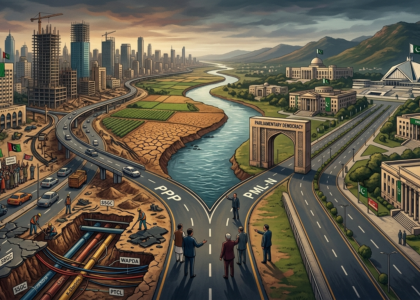
When we talk about Politics, the first thing that comes to our minds is that arguments are worthless. However, I think we just have to keep working on political matters and portray the ideas that come to mind, whether the higher authorities agree with them or not. Currently, the national political figures are figuring out the national & International-level matters. However, the provincial government of Sindh is transforming & shifting. Bilawal Bhutto Zardari seems like he is willing to gather the Bhutto family that was scattered and trying to revive the politics of his late grandfather’s hometown, Larkana. In Addition, if we compare the financial expenditure of President Zardari’s hometown, Nawabshah & Bhutto’s hometown, Larkana. The book tells us that Larkana has been a priority of the PPP Leadership, and that is why the government expenditure of Larkana exceeds approximately Rs. 5 billion more than Nawabshah in every budget. However, politically, the PPP is unfortunately facing several internal controversies from Karachi to Kashmore. Several Controversies that came into the limelight of the media. Some are already resolved, while some are still intact, and that is what calls for the reformation in code of conduct, unity, accommodation, and hierarchy of the leadership. In Karachi, Murtaza Wahab-Abdullah Murad-Saeed Ghani differences were not hidden, but things are gradually changing positively. In Hyderabad, the ongoing rifts between Jam Khan Shoro-Sharjeel Inam Memon and Rawal Sharjeel are yet to be resolved. If we talk about the confrontations, we have the Junaid & Jameel, Valasai & Arbabs controversies. Similarly, the Provincial President and Speaker of the Provincial Assembly confrontation came into the media & discussed widely. Moreover, the political stronghold of Faryal Talpur’s region from Nawabshah onwards is getting weaker and definitely requires further attention towards the matters. In Faryal Talpur & Zia Lanjar’s region, people have joined and left the party again & again. In fact, the region requires infrastructure development excessively, especially in the rural areas, where infrastructure is not fully rehabilitated after the recent floods. Specifically, from the Home Minister’s constituency to MPA Sheraz Rajper’s constituency. Both MPA’s are known as the confidantes of Faryal Talpur and retained the seats once or twice. Sheraz Rajper’s & Shar Community confrontations are still intact. On the other side, the grievances of other MPA’s from the same region had to be acknowledged. For instance, the news surrounding the former MPA Sattar Rajper is trying to join the PPP again, Ali Hassan Shah is already elected from the same constituency. There’s a sense of feeling that the MPAs are not equally treated by the leadership, and that is why they cannot fulfill the promises in their constituencies. Moreover, most of the MPAs of Sindh were seen as neglected in terms of constituency development requirements, accommodations, and public distribution. In this dire situation, one thing serves as a positive impact, which is the committee that is constituted by the Chief Minister, Murad Ali Shah, for the Local Government Matters. Nonetheless, the Chief Minister is known for his financial management, but it is difficult to fulfill the requirements of all MPAs. The reforms are necessary to constitute further matters and hear the grievances of senior political leaders & parliamentarians.