
As time passes, it is getting difficult for a media & political student like us to raise questions. Somehow, we manage to keep raising the issues with the authorities and citing references. Well, we consider the house (Provincial Assembly) to be out of order. The Provincial Assembly is a place where we see legislators themselves act as if the house does not belong to them, and rather, we witness an approach that elevates a public representative individually. The morality of politics is turned into a remote-controlled democracy, and victimizing the political opponent, even if it belongs to the same political wing.
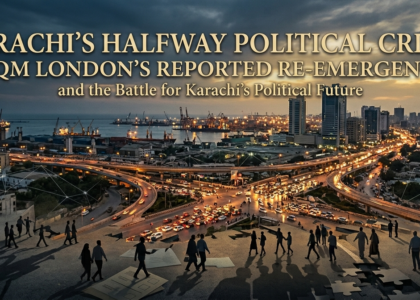
Recently, we have seen the rifts that expose the difference between MQM and former PSP Members. However, I will quote a byline of the “Dawn”, it says “Governor Tessori denies grouping within Muttahida. Says MQM-P ‘United’ under Khalid Maqbool’s leadership. Rs. 5 billion uplift packages being readied for Sindh’s second largest city”. However, the disgraceful rifts of the parliamentarians will not only cost a parliament legitimacy, but it will also result in demoralizing the voters of their respective constituencies.
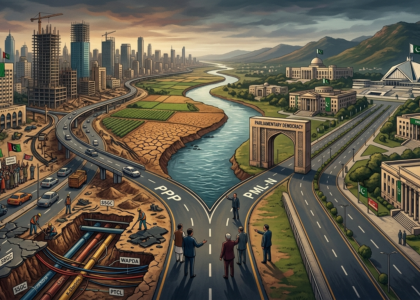
Respectfully, the ruling party that claims itself as the champion of democracy is not behind in this deteriorated situation. A conflict between Speaker Sindh Assembly and the ruling party’s provincial president over the appointment of Secretary Public Accounts Committee has been the talk of the town. Surrender Valasai & Arbabs of Tharparker is also one of the examples that came on the front. Whereas the Chief Executive & Chief Minister of the province feel helpless in front of their respective leadership. The news claims that the Chief Minister has been unable to take a stand and had to fulfil the orders of President Zardari, Chairman Bilawal, and, simultaneously, the President of the Women Wing, Faryal Talpur.
Recently, some of the rivals that joined the PPP are also a reason behind rifts & controversies among parliamentarians and politicians. Although members also suggested that the workers raise their respective concerns through the party president in writing. However, it is also necessary to understand that we are not party members and have complete freedom to talk about the public representatives. As we know, the public looks after them for the resolution of their matters, whether personal or public.
The diverse conflicts portray that there’s a problem in constituted code of conduct. Nonetheless, the decisions can be revoked and reversed with a sense of advancement in providing a better political culture with a continuous, prosperous political legacies & political values according to democratic norms.
I’d quote a request note addressed to the speaker of the Sindh provincial assembly, written by the Public Accounts Committee chairman. In 5th Para of the letter Khuhro writes “It is submitted that during the last two PAC tenures (2013-2023), when Mr. M.H.M. Hassan Shah served as Additional Secretary PAC and Secretary PAC, the total recoveries over the entire decade amounted to only Rs. 971.96 In sharp contrast, the present PAC within just 16 months has achieved an unprecedented recovery of Rs. 26 billion. This remarkable performance has been possible due to the dedicated support, professional competence, and effective supervision of Mr. Muhammad Khan Rind in his capacity as secretary PAC. Regrettably, the undersigned was not consulted prior to the transfer of Mr. Muhammad Khan Rind. His removal from PAC is likely to adversely affect the continuity, momentum, and overall effectiveness of the committee’s function. 6th para defines the kind & extended humble request to withdraw the transfer notification of Mr. Muhammad Khan Rind. Afterwards, the governance turned into a confrontation and an ego war initiated to retain the powers. An issue that could have been resolved with consultation, but was deliberately delayed until the present date.
Apologetically, the dual standards of the leadership are also portrayed in this context. On one side, a committee to address and resolve the issue is being formed in the Valasai-Arbab’s conflict. On the other side, the provincial president of the same party has to face the matters himself. I have ample examples of internal rifts to quote, but I am quoting the two examples that came in a limelight widely & publicly.
It feels like the PPP leadership is on the road to a ” forgive & forget” policy and allowing rivals to join their political party. However, I am unable to decide whether it’s for the sake of Democracy or Power Politics. A heart replies that it’s an injustice because of the dark history & conflicts between PPP members and rivals. While the mind replies that it is a powerful move to gather the rivals. In both replies, the question raised is how the party leadership is going to accommodate the rivals and loyalists simultaneously. I am unable to question the ambitious chairman of the PPP, the President’s kingmaker, or the provincial President Women Wing Faryal Talpur’s mindset & their gimmick to retain power even if it hurts the loyalists’ sentiment.
Let’s take an example of Ameer Bux Bhutto. We have been hearing the rhetoric & repeated abusive or unethical language used against the PPP loyalists in local political gatherings held in Bhutto’s hometown, Larkana. The tactics to regain the legacy of Bhutto’s dynasty are undoubtedly a powerful move yet! The loyalist voter will be disappointed with this decision. Watching the rivals and loyalists sitting under one roof brings back cherished memories of Mohtarma Benazir Bhutto, but the missing factor is the leadership’s warmth towards loyalists.
Respectfully, I cannot write or question much. The sword of Peca lies upon students, writers, and journalists. I am afraid I have nothing but to quote a reference citation from President Zardari’s biography written by the former spokesperson Farhatullah Babar. Recalling the old times when the defamation acts were not formed, nor implemented properly, especially for politicians in opposition. “TFT (The Friday Times) published a false report in such a gup about the President’s contracting another marriage. He said, “Somehow, Shaheed Bibi thought the report might be true. After some time, when the report turned out to be false, I asked her to file a defamation suit against TFT. Bibi approached a lawyer, but she advised against it. Saying that the media would only splash more dirt. Zardari regretted that, ignoring his suggestion, Bibi did not engage another lawyer. Farhat asks why he regretted it when Bibi herself did not want to pursue it, and he himself did not care about the media maligning him. The President replies, “Samjho Farhatullah, history must be corrected.”.
Another example of how a leader acts when they regret the decisions they made by listening to the wrong advice and face the consequences of it while turning back things in a rightful manner. I’d wish the acrimony between PML-N, PPP, and the military that turned into a prosperous partnership continues for another tenure. The reason behind this reference is not to malign but to portray the learning of how things happen in a political circle when the leader makes a wrong decision. In February 2009, the Supreme Court disqualified Shehbaz Sharif from being elected as an MPA, forcing him to quit the office of the Chief Minister. Taking advantage of this, Zardari swiftly sacked Shehbaz Sharif’s provincial government and imposed governor’s rule in Punjab. Soon, Zardari realized the mistake and asked the government to support appeals against the disqualification. With disarming candour, Zardari said no one but he alone, was to blame for the blunder. “I was given wrong advice,” he admitted that it was his mistake to have accepted the wrong advice, ending the internal controversy by accepting total responsibility for the fiasco. This example shows the dignity of the leader. He admits and learns from his mistakes.
Today, the provincial minister of information extends his full support to the journalists and their fraternity. However, he refuses to entertain the internal rifts and divisions in the journalist fraternity. Undoubtedly, just like any other sector, differences of opinion happen in the media fraternity too. One can agree, & other can disagree with the opinions of an individual. Nonetheless, it is also important to write that the provincial minister of information himself or his team at the PPP digital media cell sometimes have to go through a rough patch, and the media fraternity knows that well. Similarly, we hear the news of allegations raised against the policemen and the bureaucrat. We have a recent example of DIGP Pir Muhammed Shah. However, I believe in a quote, “innocent until proven guilty”.
It is an ideal time to reform the laws or implement the law from the perspective that civil-military relations are flourishing. Whereas, the interior minister and a former journalist are considered the favorites of the serving generals, including the head of the armed forces, the President, and the Prime Minister. Simultaneously, the Portfolio of Provincial Minister of Law, Parliamentary Affairs, and Home is designated to an individual who is also considered a confidante of the ruling party’s top leadership.
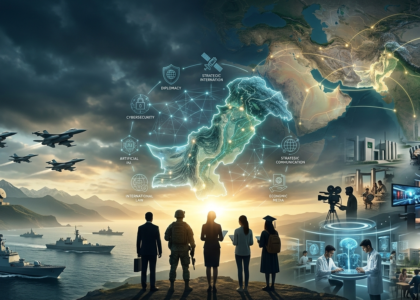
In recent years, widening ideological deviations among political parties and their opponents have intensified polarization, often shifting focus from governance to confrontation. This evolving landscape, amplified by rapid technological change and an increasingly influential media ecosystem, demands structural reforms across policing, intelligence coordination, cyber governance, and media laws. Modern policing must transition toward data-driven, community-centered models with greater accountability and professional autonomy. Intelligence agencies require enhanced inter-agency integration, strategic foresight capabilities, and legal clarity to counter hybrid and asymmetric threats. In the cyber domain, robust frameworks for digital security, misinformation control, and data protection are essential to safeguard national interests without compromising civil liberties. Similarly, media regulations must strike a balance between press freedom and responsibility, curbing disinformation while preserving democratic discourse. These reforms cannot succeed in isolation; they require proactive engagement and consensus-building led by the country’s top leadership, including its strategic head, in partnership with political stakeholders and media institutions. Constructive dialogue and bipartisan commitment are imperative to strengthen institutional resilience. In this context, the collaborative working relationship between the armed forces’ technical wing and NCCIA stands as a commendable example of coordinated national security efforts, demonstrating how synergy between defense and investigative bodies can enhance operational effectiveness in an era of complex and evolving threats.