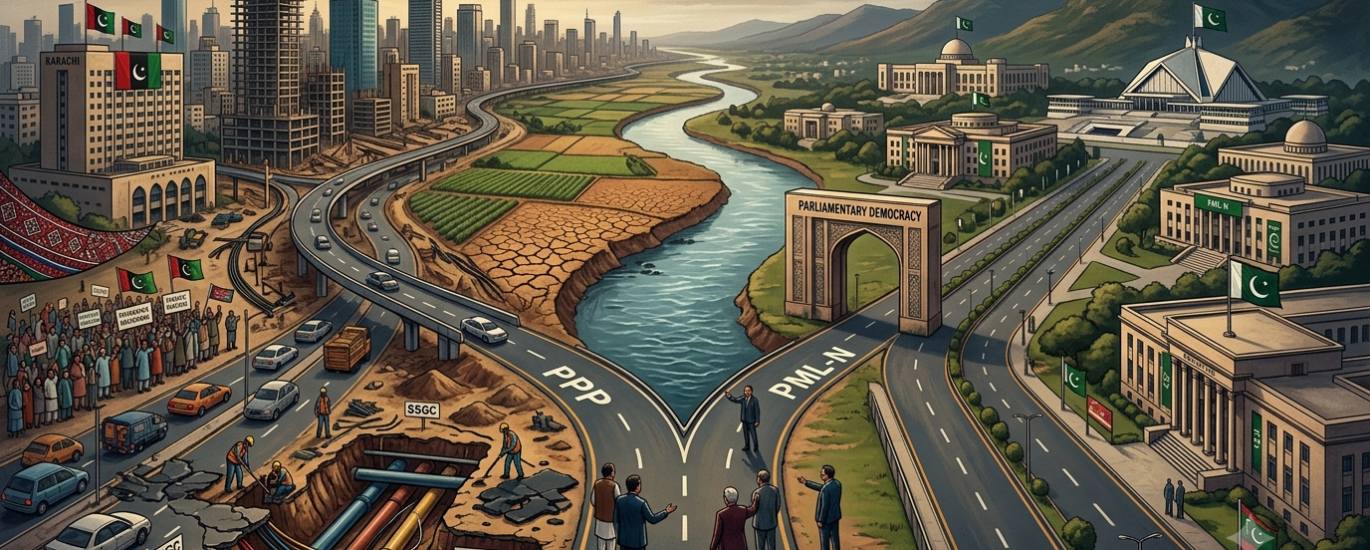
The Water Question and the Politics of Deprivation
The ongoing political differences between Pakistan Peoples Party (PPP) and Pakistan Muslim League (Nawaz) (PML-N) cannot be viewed through a single lens. While the controversy surrounding water distribution has become the most visible symbol of disagreement, the underlying issues reflect a broader debate over federal-provincial coordination, development priorities, and the future economic direction of the federation.
The slogans “Marsoon Marsoon, Sindh na Daisoon” have once again returned to the political discourse of Sindh, not merely as emotional expressions but as indicators of a historical narrative of deprivation, resource concerns, and distrust regarding decision-making processes at the federal level. For many within Sindh, the water issue represents a larger constitutional and administrative question regarding provincial rights and equitable distribution of national resources.
Beyond Water: Competing Development Visions
However, the political differences between PPP and PML-N extend beyond canals and water distribution. The development agenda and agro-based economic vision associated with President Zardari have increasingly become part of the debate surrounding the direction of national policy.
Agriculture remains the backbone of Sindh’s economy, and any policy perceived to affect water availability naturally transforms into a political issue. Consequently, disagreements over economic priorities have gradually evolved into disagreements over governance models and development strategies.
The federal coalition arrangement that once appeared stable is now being tested by competing political objectives and regional priorities.
Karachi’s Development Debate and the Coordination Deficit
Over the years, opposition political parties have frequently criticized the provincial government’s planning and execution of development projects, particularly in Karachi. Roads, infrastructure upgrades, transport projects, and urban planning have often become subjects of political confrontation.
Yet the discussion surrounding development delays is incomplete without examining the role of federal institutions and utility agencies whose operations remain interconnected with provincial projects.
Institutions such as SSGC, WAPDA, PTCL, and other service providers often operate independently of provincial development timelines. The result is a familiar cycle witnessed repeatedly by citizens: a road is completed, only to be excavated days later for utility work, followed by another agency carrying out its own infrastructure requirements.
This absence of institutional synchronization creates financial losses, public inconvenience, and political blame games between various tiers of government.
Federal Institutions and Shared Responsibility
A discussion with Sr. Journalist Rafiq Bhutto highlighted precisely this governance dilemma. His observations reflected a concern frequently raised by policymakers and citizens alike:
“Sindh Government completes the project, and next day SSGC comes in to dig, on the other day The PTCL is waiting to dig the road, simultaneously, K-Electric.”
Similar statements by politicians from different parties are already on record and continue to illustrate the structural weaknesses within Pakistan’s governance framework.
The issue therefore cannot be reduced to provincial inefficiency alone. The lack of coordination between Federal and Provincial Authorities remains one of the biggest obstacles to efficient governance and infrastructure delivery.
Gilgit-Baltistan Elections and Changing Political Equations
Political realities within coalition governments often evolve alongside electoral cycles. Following the Gilgit-Baltistan elections, the relationship between PPP and PML-N appears to have entered a more competitive phase.
Political observers increasingly believe that both parties may have temporarily separated their paths of political harmony, at least until the conclusion of the Azad Jammu & Kashmir elections.
Bilawal Bhutto Zardari’s active participation in political mobilization suggests that he is determined to position PPP as a serious contender for government formation in AJK. Such electoral competition naturally places pressure on coalition dynamics at the federal level, where cooperation in governance coexists with rivalry in electoral politics.
This is not unusual in parliamentary democracies, but it does require political maturity and continuous dialogue among coalition partners.
Sindh’s Political Sentiment and Federal Grievances
The intensity of protests witnessed across Sindh demonstrates that dissatisfaction with federal authorities extends beyond a single issue.
Whether concerning resource allocation, development priorities, or institutional coordination, many political workers and citizens perceive a widening gap between provincial expectations and federal responses.
It is within this political environment that slogans such as “Marsoon Marsoon, Sindh na Daisoon” regain relevance and emotional significance.
Political slogans often emerge when communities believe their concerns are not being adequately addressed through conventional institutional mechanisms.
Internal Challenges Within PPP
The external political pressures facing PPP have coincided with internal political adjustments within Sindh itself.
Several internal disagreements eventually transformed into political truces, while others continue to exist in the form of minor differences of opinion. Among the most discussed controversies were the reported differences between the provincial president of Sindh Nisar Ahmed Khuhro and Chief Minister Murad Ali Shah.
Journalistic and professional ethics do not always permit the disclosure of discussions held in unofficial gatherings. Nevertheless, public political conduct often speaks louder than speculation.
The manner in which Nisar Ahmed Khuhro publicly defended his party’s Chief Minister significantly weakened narratives suggesting serious divisions between Khuhro and Murad. Political disagreements may exist within every democratic party structure, but institutional solidarity often determines whether such disagreements evolve into crises.
Accountability and the Responsibilities of Governance
Similar controversies regarding tensions between Chief Ministers and party members frequently emerge in political discourse and often prove exaggerated or baseless.
However, the responsibility of journalism remains unchanged.
If administrative negligence, irregularities in government policies, or corruption occur through any PPP representative within Sindh, criticism of Murad’s administration will remain both legitimate and necessary because democratic accountability ultimately rests with those holding executive authority.
Political support cannot replace administrative responsibility.
The Need for Structural Reforms Within Political Parties
The existence of internal rifts, policy disagreements, and organizational pushback suggests the need for a renewed code of conduct and structural reforms within political parties.
A more harmonious relationship between government administrators and party cadres is essential for improving governance outcomes and reducing internal friction.
Political organizations evolve, and periods of disagreement often create opportunities for institutional reform and organizational renewal.
MQM’s Position and Coalition Politics
On the federal front, MQM has increasingly adopted a critical tone toward the PML-N government despite remaining part of the ruling coalition.
Many observers view this as a natural feature of parliamentary democracy, where coalition partners retain the right to disagree on policy matters while continuing to support broader governance arrangements.
Others interpret MQM’s political positioning differently and view it as an indication of possible future political realignments involving PPP at both the federal and provincial levels.
Whether such analyses prove accurate remains to be seen, but coalition politics in Pakistan has always remained fluid and dynamic.
Judiciary, Governance and Public Perception
Public confidence in institutions remains one of the pillars of democratic stability.
While the judiciary continues to be regarded as a symbol of justice and constitutional order, debates surrounding decisions such as the Nasla Tower verdict have contributed to public discussions regarding fairness, proportionality, and institutional accountability.
The episode serves as a reminder that no institution remains beyond public scrutiny in a democratic society.
The Missing Political Facilitators in a Changing Political Environment
Another noteworthy feature of the current political landscape is the relative absence from the limelight of three individuals who, in different political circles, have often been regarded as important political manoeuvring facilitators during periods of negotiation, coalition management, and electoral strategy.
Sharjeel Inam Memon has frequently been viewed by political observers as an influential political operator for Bilawal Bhutto Zardari, PPP, and Sindh’s political interests.
Similarly, Faryal Talpur has long been associated with political management and electoral manoeuvring within Azad Jammu & Kashmir, particularly during crucial electoral contests.
On the federal side, Mohsin Naqvi has emerged as an important bridge between the Federal Government and Military Leadership during a period that demands coordination and political consensus.
Whether in coalition management, electoral strategy, or institutional communication, all three figures possess networks and political capital that can contribute significantly to reducing tensions and facilitating dialogue during an increasingly complex political environment.
The Need for Political Reconciliation
The present political environment demands greater coordination rather than greater confrontation.
The burden of coalition management largely falls upon Pakistan Muslim League (Nawaz) as the leading federal partner. Addressing the grievances and concerns of political allies and supporters is not merely a political necessity but a governance requirement.
Pakistan’s governance challenges increasingly involve multiple layers of administration, institutions, and political stakeholders. Without improved coordination between Federal and Provincial Authorities, developmental ambitions will continue to encounter administrative obstacles and political resistance.
Ultimately, coalition governments survive not through electoral arithmetic alone but through consultation, mutual respect, and an understanding that political stability remains essential for economic development and institutional progress.