
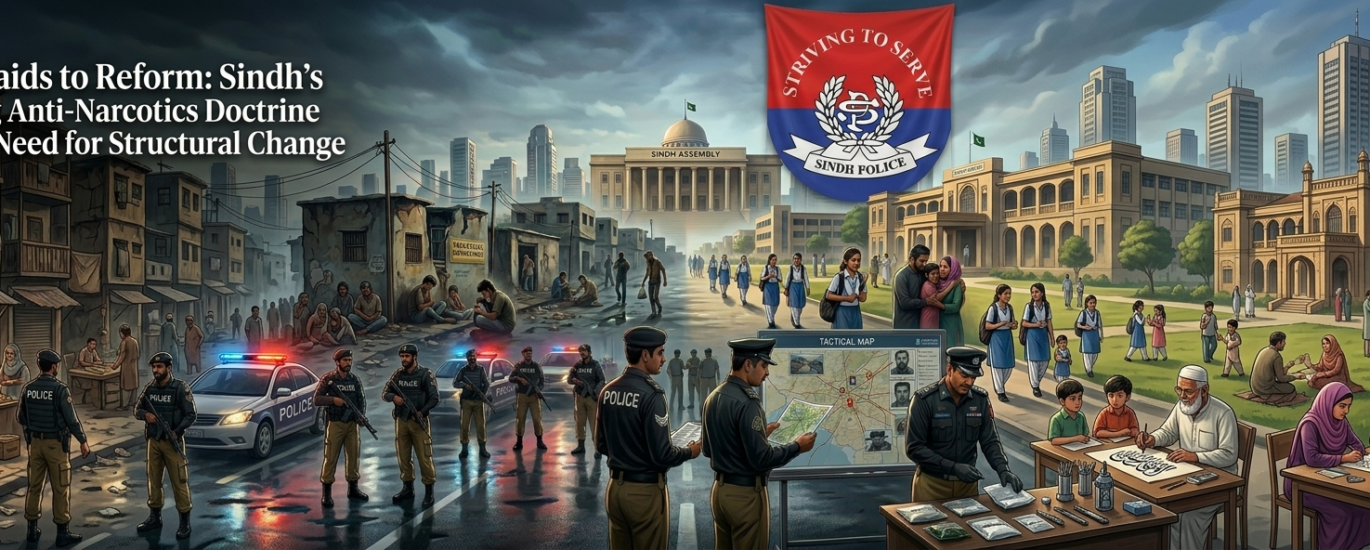
As Pakistan continues to confront the expanding menace of narcotics, particularly among its youth population, Sindh has emerged as one of the few provinces attempting to transform anti-drug operations from routine enforcement into a broader governance and social intervention framework. Over the last three years, from 2023 to 2025, the anti-narcotics campaign in Sindh has evolved considerably — operationally, politically, and administratively. Yet despite measurable gains, the crisis remains far from over.
The comparison between 2023 and 2025 reveals not merely an increase in raids or arrests, but a gradual transition toward institutional seriousness. Nonetheless, the most important lesson remains clear: narcotics cannot be eradicated through policing alone. The challenge is deeply social, judicial, educational, and legislative.
2023: Reactive Enforcement and Fragmented Strategy
The year 2023 represented a largely reactive phase in Sindh’s anti-narcotics efforts. Operations existed, recoveries were conducted, and drug peddlers were arrested, but the broader framework lacked coordination and long-term vision. Enforcement agencies were primarily responding to visible street-level criminality rather than dismantling organized narcotics networks.
Karachi, Hyderabad, and several urban pockets witnessed increasing concerns regarding the accessibility of narcotics among students and young adults. Educational institutions, particularly schools, colleges, and universities in Karachi, gradually became vulnerable spaces where synthetic drugs, hashish, and crystal methamphetamine, commonly known as “ice,” were reportedly circulating with alarming ease.
While the police and excise authorities conducted raids and seizures, the overall anti-drug doctrine remained enforcement-centric without sufficient rehabilitation infrastructure, public awareness mechanisms, or legislative urgency.
2024: Strategic Expansion Under the Senior Cabinet Minister
The year 2024 marked a comparatively more organized and politically visible phase. Under the stewardship of the Senior Cabinet Minister Sharjeel Inam Memon, during his tenure overseeing the Anti-Narcotics Department, the provincial government expanded the scope of anti-drug operations significantly.
What distinguished the 2024 approach was not merely the increase in crackdowns, but the articulation of narcotics as a societal crisis rather than only a policing issue. The Sr. Cabinet Minister repeatedly emphasized that the core consumers of these narcotics were the youth of Pakistan, particularly students in Karachi’s educational institutions.
More importantly, he consistently advocated for the inclusion of parents, teachers, civil society, and communities in the anti-narcotics campaign. This was a critical shift in the narrative. For perhaps the first time in recent provincial discourse, the government publicly acknowledged that the narcotics epidemic could not be addressed through force alone; society itself had to become a stakeholder.
The department intensified:
- intelligence-based operations,
- inter-agency coordination,
- surveillance of urban narcotics hubs,
- and actions against organized supply chains.
At the same time, the Sindh Police also deserve commendation for their operational performance during this period. Numerous raids, recoveries, and targeted actions demonstrated institutional seriousness, particularly against drug peddlers operating near educational zones and densely populated urban areas.
Yet despite these improvements, structural weaknesses persisted. Arrests often did not translate into convictions. Trials remained painfully slow. Drug networks adapted faster than prosecutions progressed.
2025: Institutional Momentum Under Faryal Talpur’s Directives
By 2025, the anti-narcotics campaign appears to have entered a more mature and results-oriented phase. Under the directives and political backing of Faryal Talpur, the crackdown has produced notable administrative and operational outcomes.
The provincial administration has demonstrated greater consistency in pursuing narcotics networks, while the Excise and Anti-Narcotics Department under Mukesh Kumar Chawla has repeatedly presented operational achievements and departmental initiatives on the floor of the Provincial Assembly. This parliamentary visibility is important because it institutionalizes accountability and keeps the issue at the center of public governance discourse.
The 2025 phase reflects:
- improved inter-departmental coordination,
- broader intelligence sharing,
- more targeted anti-drug operations,
- and stronger political ownership of the issue.
However, despite these commendable gains, the reality remains uncomfortable: the menace continues to survive because the state still struggles to eliminate the ecosystem sustaining it.
The Real Weakness: Judicial Delays and Weak Rehabilitation
The most significant weakness in Pakistan’s anti-narcotics framework is not the absence of raids. It is the absence of swift justice and meaningful rehabilitation.
Drug traffickers often exploit:
- prolonged judicial trials,
- weak prosecution mechanisms,
- procedural loopholes,
- and insufficient witness protection structures.
Meanwhile, addicts themselves frequently remain trapped between criminalization and neglect. Pakistan’s rehabilitation infrastructure remains grossly inadequate for the scale of addiction now visible among youth populations.
Without:
- modern rehabilitation centers,
- psychological support systems,
- reintegration programs,
- and preventive educational campaigns,
The cycle merely reproduces itself.
This is precisely why the anti-narcotics debate must now move beyond operational statistics and evolve toward legislative and structural reform.
The Need for Legal Amendments and Administrative Realism
There is an increasing need to revisit and amend several legal provisions related to heinous crimes, particularly narcotics-related offenses and honor killing laws, where procedural weaknesses and legal ambiguities continue to undermine deterrence.
In this context, the role of the provincial Home Minister becomes particularly important. The fact that the Home Minister simultaneously holds the portfolio of Law and Parliamentary Affairs provides a significant administrative advantage. It creates an opportunity for coordination between enforcement realities and legislative reform.
But meaningful reform will ultimately depend upon political will at the highest level.
The interest and backing of both Faryal Talpur and the Chief Minister are therefore central to any serious attempt at:
- strengthening narcotics laws,
- accelerating judicial procedures,
- improving prosecution frameworks,
- and aligning legislation with ground realities.
Beyond Crackdowns
Sindh’s anti-narcotics journey between 2023 and 2025 demonstrates that the province is gradually transitioning from symbolic enforcement toward a more structured governance approach. The improvement is visible, and the results achieved in 2025 deserve acknowledgment.
Yet narcotics are not merely a law & order issue; they are a national social emergency.
The true success of this campaign will not only be measured through raids, arrests, or recoveries, but through:
- safer educational institutions,
- rehabilitated youth,
- stronger convictions,
- empowered families,
- laws capable of confronting modern criminal networks.
The crackdown has begun to produce results. The next challenge is ensuring that those results become permanent.
The Evolving Face of Sindh Police in the Anti-Narcotics Campaign
Another important dimension of Sindh’s evolving anti-narcotics campaign is the visible operational transformation within the police force itself. The Sindh Police, under the leadership of Javed Alam Odho, deserves considerable commendation for adopting increasingly intelligence-based operations against organized criminal and narcotics networks.
The Police Chief has consistently been recognized for emphasizing ground-level intelligence, surveillance coordination, and network-based policing rather than relying solely upon conventional reactive enforcement.
The results achieved over recent years are not merely a testament to the bravery and courage of police personnel operating under dangerous conditions; they also reflect a gradual but visible behavioral and institutional shift within the force itself.
This transformation demonstrates an important reality often ignored in public discourse: when policing institutions receive strong political backing, administrative continuity, and operational independence, they possess the capacity to improve governance and deliver impactful results.
More importantly, this evolving professionalism also presents Sindh Police with a historic opportunity to gradually erase the longstanding stains of systematic corruption, political interference, and public mistrust that have shadowed the institution for decades.
The continuation of intelligence-led policing, combined with political ownership and structural accountability, may ultimately become one of the most significant institutional reforms emerging from Sindh’s broader anti-narcotics drive.