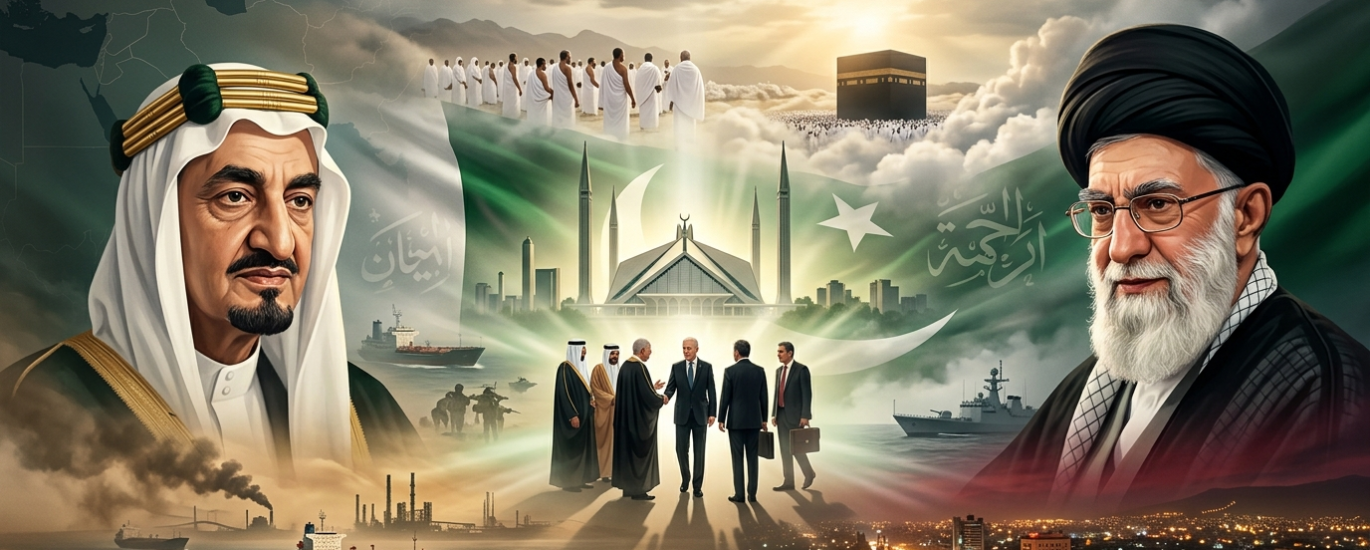
As the blessed days of Hajj unfold and the Day of Arafat arrives, a day deeply associated with mercy, repentance, and unity. The Muslim world finds itself once again confronting conflict, uncertainty, and geopolitical anxiety. Yet amid these turbulent regional developments, one must first extend heartfelt congratulations and prayers to the pilgrims of Hajj who have gathered in the sacred plains of Arafat seeking forgiveness, peace, and spiritual renewal.
May Allah accept their prayers, sacrifices, and devotion. May this sacred occasion bring stability to the Muslim Ummah, relief to oppressed populations, wisdom to Muslim leadership, and harmony among nations struggling with division and war.
At a time when the Middle East remains under extraordinary strain, Pakistan’s emerging diplomatic role between Iran and the United States represents a notable strategic and political achievement. The country’s quiet but calculated mediation efforts not only strengthened bilateral trust with key regional stakeholders, but also helped Pakistan regain a measure of diplomatic sanctity and relevance on the international stage, something that had gradually diminished over years of political instability and inconsistent foreign policy positioning.
This diplomatic engagement demonstrated that Pakistan still possesses the strategic credibility to function as a bridge between competing powers within the Muslim world and beyond. More importantly, it reinforced the long-standing perception that Pakistan’s geopolitical importance extends far beyond military geography; it also lies in its ability to mediate crises, absorb regional pressures, and maintain dialogue with rival states simultaneously.
The significance of this role becomes even more important when viewed alongside Pakistan’s internal social fabric, particularly the province of Sindh, which has consistently attempted to project an image of religious harmony, coexistence, and tolerance despite immense political pressures and sectarian sensitivities.
Within Sindh’s political landscape, the foundation of this pluralistic approach was significantly strengthened under the leadership of the Chairman of the Pakistan Peoples Party. Despite criticism from ideological opponents and repeated political resistance, the party’s public stance regarding minority rights, interfaith coexistence, and ethnic inclusivity has largely remained uncompromised.
One symbolic example recently emerged when Sindh’s Chief Minister, Syed Murad Ali Shah, and local government minister, Syed Nasir Hussain Shah, himself belonging to the Ahl-e-Bait tradition, publicly expressed condolences and prayers upon the passing of Hindu spiritual leader Sant Sain Sadhram Sahib. Such gestures may appear symbolic to some observers, yet in deeply polarized societies, symbolism often becomes a powerful instrument of social cohesion.
This broader atmosphere of coexistence also reflects Pakistan’s larger regional balancing act. Despite intensifying regional rivalries and global pressure campaigns, Pakistan continues to maintain working relations simultaneously with Saudi Arabia, Iran, and the Gulf states. That diplomatic equilibrium itself sends a powerful message: despite internal disagreements and geopolitical breakages, the Muslim Ummah still retains the capacity for strategic unity.
However, such unity is neither accidental nor effortless.
It is built through sustained diplomatic engagement, military preparedness, border management, intelligence coordination, and political communication. Pakistan’s recent regional posture reflects the combined functioning of both civilian and military institutions, a reality that once again highlights the importance of stable civil-military coordination during moments of international crisis.
In this regard, the efforts of Asim Munir, Shehbaz Sharif, the former foreign minister, and the Chairman of the Pakistan Peoples Party deserve acknowledgment for sustaining diplomatic engagement during a period of heightened regional instability. Similarly, the presence and coordination of Mohsin Naqvi alongside military leadership during the Tehran-related diplomatic engagements reflected institutional synchronization rather than fragmented policymaking.
Equally important are the longstanding political relationships maintained by Pakistan’s major political parties with regional capitals. Saudi Arabia’s historical relations with the leadership of the Pakistan Muslim League (N) and Iran’s relatively warmer engagement with segments of the Pakistan Peoples Party may also have indirectly contributed toward sustaining channels of communication during tense negotiations.
What makes these diplomatic developments particularly significant is that they unfolded despite domestic controversy and political polarization. Even amid criticism directed toward the military leadership by certain religious circles, the state institutions continued pursuing dialogue and de-escalation with strategic patience.
This ultimately demonstrated that slogans such as “Nara-e-Takbeer” and “Nara-e-Haideri” are not merely ceremonial chants confined to parade grounds or moments of conflict. Rather, they continue to resonate as emotional and ideological sources of resilience during war, diplomacy, and national hardship alike.
The current regional tensions surrounding the Strait of Hormuz and Iran’s posture toward Western pressure also invite important historical comparisons. The statements and strategic posture adopted by Ali Khamenei are not entirely unprecedented in Middle Eastern political history. Similar rhetoric emerged during the 1973 oil crisis under the leadership of Faisal bin Abdulaziz Al Saud.
King Faisal viewed the oil embargo not merely as an economic measure, but as a moral and political response to Western support for Israel during the Arab-Israeli conflict and the Palestinian issue. His statements emphasized dignity, sovereignty, sacrifice, and resistance to external pressure.
Among the most widely remembered remarks attributed to him were:
“We can easily live without oil. We lived for centuries without it before.” And similarly: “Our forefathers lived on dates and milk, and we can do so again.”
These statements symbolized Saudi Arabia’s willingness under Faisal to endure economic hardship in pursuit of political principles.
In a somewhat parallel manner, Ali Khamenei has repeatedly framed Iran’s confrontation with Israel and the United States as ideological and structural rather than temporary geopolitical disagreements. Statements such as:
“Israel will be punished.” And “We will never compromise with Zionists,” reflects Iran’s continued refusal to normalize relations under prevailing regional conditions.
Likewise, his characterization of conflict with the United States as “inherent” illustrates Tehran’s belief that the confrontation is systemic so long as Washington maintains strategic and military influence in the region.
During the Gaza escalation, Khamenei’s appeal to Muslim governments to:
“Cut off political, propaganda, and arms aid,” echoed, in certain respects, the collective pressure tactics witnessed during the 1973 oil embargo. Yet there remains a major distinction between the two historical moments.
The 1973 crisis demonstrated how Middle Eastern oil-producing states could leverage energy markets to influence global politics. Modern Iran, however, operates under prolonged sanctions, economic isolation, and regional containment strategies. Consequently, Tehran’s contemporary approach relies more heavily on geopolitical positioning, maritime leverage, missile deterrence, and regional alliances than purely economic instruments.
Back home, Pakistan’s internal political environment also reflected this broader atmosphere of national solidarity. The Chief Minister of Sindh recently introduced a resolution in the provincial assembly commending the military leadership for its role during the Indo-Pak conflict and the country’s broader diplomatic achievements.
At the same time, Sindh continues to experience political tensions surrounding governance disputes, opposition criticism, and debates connected to the proposed “28th Constitutional Amendment.” Amid these confrontations, Sindh’s Senior Minister Sharjeel Inam Memon proposed political reconciliation and urged opposition parties to work collaboratively rather than deepen polarization. He also publicly commended the diplomatic efforts of Asim Munir and Shehbaz Sharif on the international front.
Ultimately, Pakistan’s recent diplomatic posture reflects an important reality: in a deeply fragmented region, influence no longer emerges solely through military capability or economic leverage. It also emerges through mediation, political maturity, interfaith tolerance, and institutional cohesion.
As the Muslim world observes the sacred spirit of Arafat, perhaps the larger lesson for the region lies precisely here that unity is not built through slogans alone, but through patience, coexistence, strategic wisdom, and the courage to pursue peace even during the most difficult moments of history.