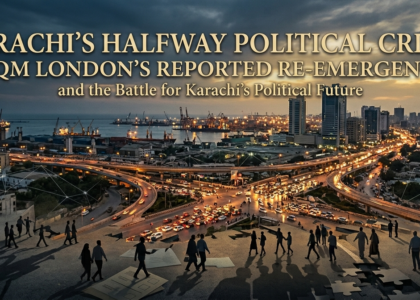

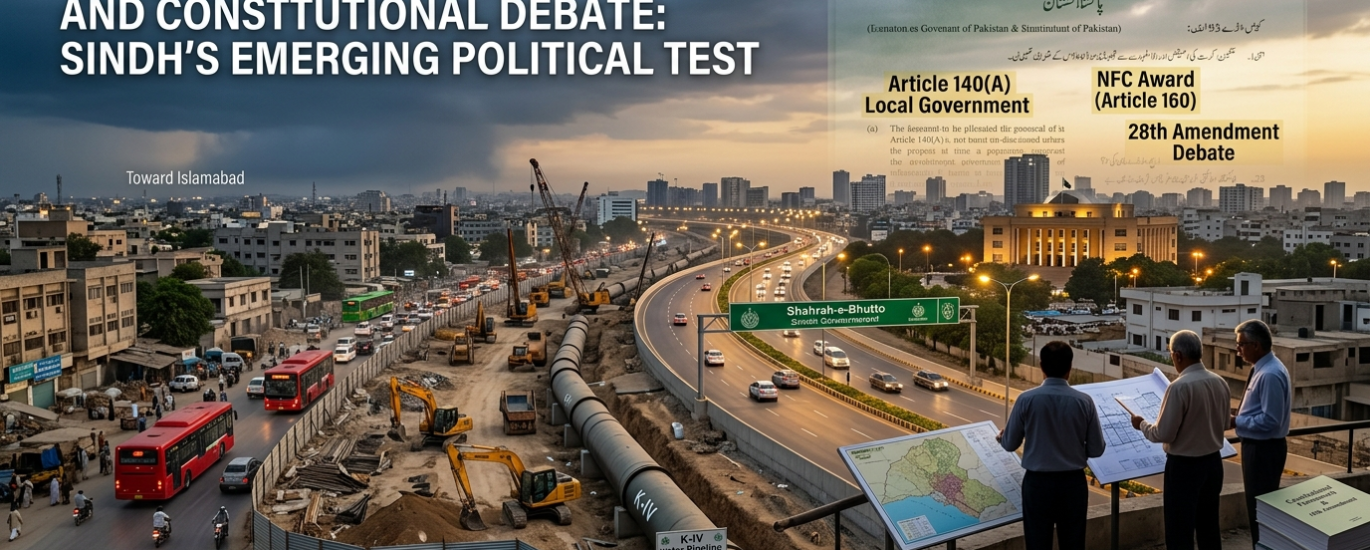
As Pakistan moves closer toward the federal budget cycle and the growing discourse surrounding the proposed “28th Constitutional Amendment,” the country’s political atmosphere is entering another phase of institutional uncertainty, administrative positioning, and inter-governmental friction. While the federal political narrative continues to revolve around constitutional restructuring, fiscal redistribution, and speculation regarding the future of provincial autonomy, the provincial government in Sindh appears to be navigating an entirely different battlefield — one shaped by governance pressures, infrastructure delivery, and relentless opposition criticism.
In recent weeks, the provincial administration led by the Pakistan Peoples Party has attempted to shift public attention toward development-oriented governance. The inauguration of major infrastructure initiatives such as Shahrah-e-Bhutto was presented as evidence that the provincial government remains focused on long-term urban transformation despite intensifying political turbulence at the federal level. Yet, while ribbon-cutting ceremonies and administrative reviews continue, the political environment surrounding Sindh has become increasingly confrontational.
The timing is particularly critical.
At the federal level, debate regarding the proposed 28th Amendment is intensifying across political circles, media discussions, and social platforms. However, despite the seriousness of the constitutional debate, one noticeable factor continues to dominate the provincial government’s position: the federation has yet to formally share any draft, framework, or working paper regarding the proposed amendment. From Bilawal Bhutto Zardari to the Sindh cabinet leadership, the official stance has remained remarkably consistent — no concrete proposal regarding the amendment or the revision of the National Finance Commission Award has been formally communicated to Sindh.
This absence of institutional consultation has amplified provincial skepticism.
For Sindh, the issue is not merely constitutional symbolism; it directly concerns the future of fiscal autonomy, provincial resource allocation, and the balance of power between Islamabad and the federating units. The NFC Award remains the backbone of provincial financial planning, and any speculation regarding its restructuring naturally generates anxiety within provincial administrations already struggling with rising development expenditures and urban governance pressures.
Yet, amid this constitutional uncertainty, the Sindh government itself remains under extraordinary pressure from opposition parties over delayed infrastructure projects and administrative bottlenecks.
The provincial administration has recently accelerated oversight meetings regarding Karachi’s ongoing Bus Rapid Transit projects. Following the inauguration of Shahrah-e-Bhutto, the provincial leadership — particularly Sharjeel Inam Memon, Syed Nasir Hussain Shah, and Murtaza Wahab — appears increasingly focused on revisiting transport and urban mobility projects that have long become centers of political criticism.
The delays surrounding Karachi’s BRT corridors, the prolonged reconstruction of University Road, and continuing questions regarding the K-IV water project have collectively created a political narrative that the opposition is aggressively weaponizing within the Provincial Assembly of Sindh and public discourse alike.
Notably, the criticism is no longer emerging from a single political front.
Muttahida Qaumi Movement-Pakistan, currently positioned as the principal opposition stakeholder in Sindh’s urban politics, has intensified its rhetoric while simultaneously engaging in negotiations with federal authorities. Reports and political discussions surrounding a proposed special development package for Karachi and Hyderabad — allegedly worth Rs25 billion — alongside demands related to amendments in Article 140(A), have further complicated the political atmosphere.
The situation reflects a familiar yet evolving pattern in Sindh’s politics.
On one side, the MQM continues pressing for stronger local government structures and greater administrative decentralization under Article 140(A). On the other, the PPP-led provincial administration perceives many of these demands as politically interconnected with broader federal pressure tactics linked to the proposed 28th Amendment and fiscal negotiations.
The overlap is difficult to ignore.
As negotiations between the federation and MQM continue, the tone of criticism directed toward the Sindh government has simultaneously intensified. The recent appointment of a governor associated with Pakistan Muslim League (N) has only added another layer of political friction. Meanwhile, senior provincial figures of PML-N have openly criticized the Sindh government over delays in the K-IV water supply project, further reinforcing opposition pressure on the provincial administration.
Within this broader political climate, the provincial cabinet increasingly finds itself at the center of public accountability.
This confrontation, however, is not newly born.
The political acrimony between PPP and MQM has remained embedded in Sindh’s urban politics since the early years of PPP’s first provincial government. Even debates surrounding Article 140(A) have historically reflected deeper disagreements regarding the interpretation of local government autonomy, administrative authority, and provincial jurisdiction.
The Sindh government has repeatedly argued that local government arrangements must operate within constitutional provincial authority rather than parallel administrative frameworks. In past years, disputes surrounding local governance and delimitation ultimately escalated to the Supreme Court of Pakistan, illustrating how deeply entrenched the conflict over urban administrative control has remained.
Consequently, current demands for further amendments in Article 140(A), especially amid simultaneous discussions surrounding the 28th Amendment and NFC Award speculation, are being interpreted by many within the provincial government as part of a broader political strategy aimed at compelling Sindh into negotiations it presently appears reluctant to entertain.
At this stage, the provincial government’s priorities appear visibly different from those of the federation.
While Islamabad’s political discourse increasingly circles constitutional restructuring and financial redistribution, Sindh’s administration seems focused on preserving political stability through visible development delivery, urban infrastructure completion, and administrative continuity. The challenge, however, is that development timelines rarely align with political impatience.
For Chief Minister Murad Ali Shah and his cabinet, the coming months may prove decisive. The pressure is no longer limited to project completion; it now intersects with constitutional politics, center-province relations, fiscal uncertainty, and Karachi’s permanently volatile political landscape.
In such an environment, every delayed transport corridor, every unfinished water pipeline, and every constitutional statement increasingly carries implications far beyond governance alone.
The core dispute revolved around the Sindh Local Government Act (SLGA) 2013:
The dispute emerged after the Sindh government introduced the Sindh Local Government Act 2013 and carried out new delimitations for local body elections in Karachi and other urban centers. The Muttahida Qaumi Movement (MQM) challenged the law and the delimitation process in the Sindh High Court, arguing that the provincial government had altered electoral boundaries and administrative structures in a manner that undermined fair urban representation and weakened local governments in violation of Article 140A of the Constitution.
The Sindh High Court, in its 2013 judgment, declared several amendments to the local government law unconstitutional and questioned the legality of parts of the delimitation exercise, observing that changes had been introduced during the electoral process without legal consistency. The Sindh government subsequently approached the Supreme Court against the ruling.
During the broader constitutional proceedings, the Supreme Court emphasized that Article 140A guarantees elected and empowered local governments, requiring provinces to devolve political, administrative, and financial authority to local bodies. The Court underscored that local governments could not function merely as subordinate administrative units under provincial control and stressed the constitutional necessity of meaningful decentralization, particularly in major urban centers such as Karachi.
The core dispute revolved around K-IV water project:
Politically, the project became a recurring point of criticism from opposition parties, particularly regarding governance efficiency and delayed delivery. Critics argued that Karachi continued to face severe water shortages despite years of announcements and revised deadlines. In response, the Sindh government maintained that the delays were linked to complex procedural, technical, and financial challenges rather than political negligence alone.
The federal government later increased its involvement through agencies such as the Water and Power Development Authority (WAPDA), which took over major portions of execution to accelerate progress and address technical concerns. The rhetoric surrounding K-IV eventually evolved beyond a simple infrastructure debate and became symbolic of the broader governance tensions between federal and provincial institutions over Karachi’s development priorities, funding responsibilities, and administrative control.
Dispute revolved Karachi’s Bus Rapid Transit (BRT) project:
The delays surrounding Karachi’s Bus Rapid Transit (BRT) projects and the reconstruction of University Road became a major governance and political controversy in Sindh. Initially launched to improve traffic flow, modernize infrastructure, and integrate mass transit corridors, the projects faced persistent delays due to utility relocation issues involving water, gas, electricity, and sewerage networks managed by multiple agencies. Financial constraints, inflation, rising construction costs, and repeated budget revisions further slowed progress. Weak coordination between provincial authorities, municipal institutions, and federal agencies also contributed to administrative bottlenecks. Prolonged construction caused severe traffic congestion, dust pollution, damaged roads, and commercial losses, triggering widespread public frustration. Opposition parties, including the Muttahida Qaumi Movement and Jamaat-e-Islami, criticized the Pakistan Peoples Party government for poor planning and weak execution. Despite criticism, provincial authorities argued the projects were essential long-term investments aimed at modernizing Karachi’s urban transport and infrastructure network.