As the debate surrounding the proposed “28th Amendment” intensifies across Pakistan’s political spectrum and social media discourse, the provincial political atmosphere in Sindh — particularly in Karachi — has entered a phase of heightened confrontation, scrutiny, and political recalibration. While constitutional debates dominate digital platforms and televised discussions, the ruling party in Sindh appears determined to shift the public narrative toward governance, infrastructure, and administrative performance. Yet the question remains whether development initiatives alone can neutralize the widening criticism emerging from opposition benches, internal concerns, and growing public frustration over civic management.
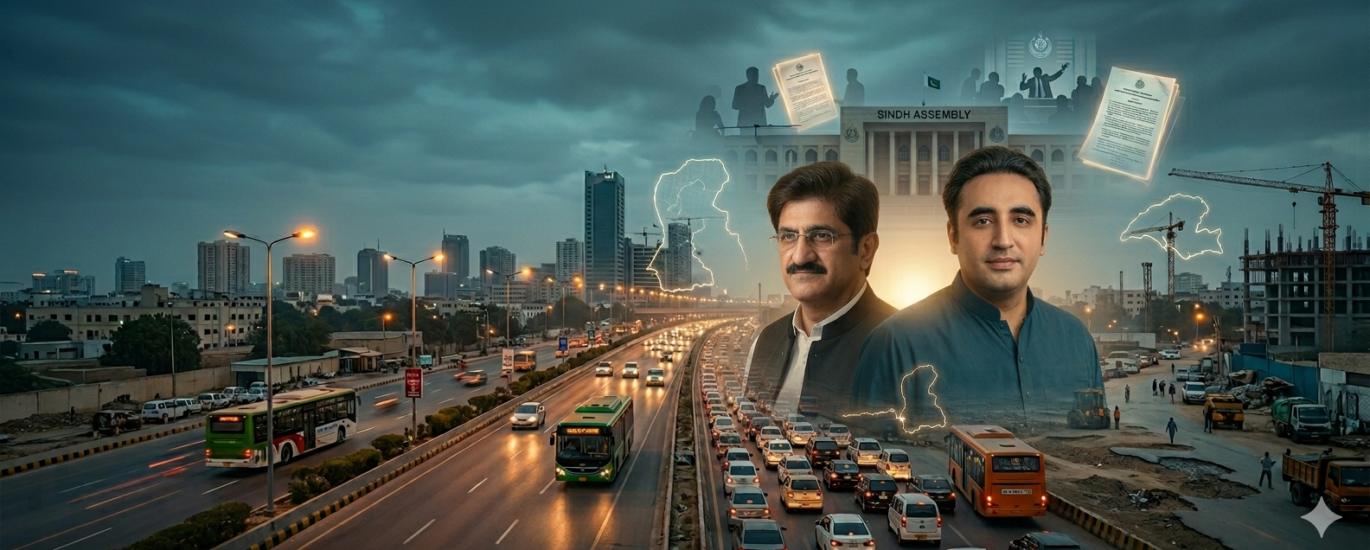
At the center of this political and administrative contest stands the inauguration and expansion of Shahrah-e-Bhutto, a flagship infrastructure project that the provincial government considers symbolic of continuity, connectivity, and urban transformation. For the ruling party, the project represents more than a road network; it is an attempt to project administrative seriousness at a time when political polarization and constitutional uncertainty continue to dominate national discourse. However, for opposition parties and Karachi’s influential political stakeholders, the project has simultaneously become a focal point of criticism regarding governance priorities, transparency, urban planning, and the broader distribution of resources.
The opposition’s criticism has become increasingly aggressive following the transition involving the MQM-backed governor’s political positioning and the intensifying rhetoric witnessed on the provincial assembly floor. Opposition lawmakers have sharpened their attacks against the provincial administration, accusing it of relying heavily on symbolic inaugurations while fundamental municipal issues — ranging from sanitation and drainage to urban collapse and institutional inefficiency — continue to burden Karachi’s residents. The criticism has been particularly vocal from Jamaat-e-Islami, which remains one of Karachi’s most influential political stakeholders and has consistently challenged the provincial government over local governance failures and administrative centralization.
Yet beneath the political slogans and assembly confrontations lies a deeper constitutional and governance debate: the question of financial decentralization and administrative autonomy for union councils. Several political voices, including some within governance circles themselves, have raised concerns that local governments remain structurally dependent on provincial authorities, limiting their ability to function independently and respond effectively to public needs. The demand for meaningful transfer of authority, financial resources, and administrative powers to local bodies has therefore re-emerged as a central theme amid discussions surrounding constitutional reforms and the proposed 28th Amendment framework.
This debate carries particular significance for Karachi, a city whose governance structure has historically remained trapped between overlapping authorities, political rivalries, and institutional fragmentation. Critics argue that without genuine empowerment of union councils and local administrations, no infrastructure project — regardless of scale — can sustainably address the city’s long-standing governance crisis. Supporters of decentralization maintain that local representatives must possess the authority to manage municipal affairs independently instead of functioning under excessive provincial dependency.
The Shahrah-e-Bhutto project itself reportedly posed considerable financial and administrative challenges for the provincial leadership, particularly for Murad Ali Shah and Sindh’s financial management team. Amid economic uncertainty, inflationary pressures, and ongoing tensions regarding federal-provincial fiscal transfers, managing large-scale infrastructure development while simultaneously preparing for a politically sensitive provincial budget has become an increasingly delicate balancing act.
Complicating matters further is the emerging narrative from the ruling party regarding financial constraints and the federal government’s alleged failure to adequately address Sindh’s fiscal concerns. Statements from senior provincial leadership suggest that tensions over resource allocation may soon become a major political battleground between the federation and the province. One senior provincial figure recently remarked that if authorities remain unable to resolve issues linked to WAPDA and broader federal financial matters, provincial governance itself risks further strain. Such statements indicate that the upcoming budget session may evolve into more than a routine legislative exercise; it could become a political confrontation over constitutional authority, fiscal rights, and administrative responsibility.
Adding to the evolving political landscape, Saeed Ghani — who had remained comparatively less visible in recent months while defending and representing his political party — returned to the public discourse with a notably cautious yet politically significant statement. Acknowledging the province’s financial limitations, he admitted that the upcoming budget may not fully meet public expectations regarding relief measures and economic assistance. Nevertheless, he emphasized that the government would attempt to provide maximum possible facilitation within existing constraints.
More significantly, Saeed Ghani’s remarks regarding Karachi’s historical political environment triggered considerable debate. Referring to the city’s past periods of fear, coercion, and political shutdowns allegedly associated with a particular political faction, he argued that today’s Karachi — despite its visible administrative problems — cannot be compared to earlier eras characterized by political intimidation and silencing of media voices. His controversial statement effectively suggested that if the current deteriorating civic conditions are being attributed to the ruling party, then comparisons must also acknowledge the transformation from the violence-driven political climate that once dominated the city.
While such statements may resonate with sections of the ruling party’s supporters, they also expose the difficult political reality confronting the provincial government: development narratives alone are insufficient when citizens continue to experience urban deterioration, administrative inefficiency, water shortages, traffic congestion, and municipal collapse in daily life. Public frustration increasingly stems not merely from partisan politics but from visible governance fatigue.
In this environment, local government reforms have become indispensable. The administrative structure of Karachi and broader Sindh requires serious institutional restructuring if governance is to become efficient, transparent, and publicly responsive. Political observers argue that constitutional reforms linked to the 28th Amendment debate should not remain confined solely to federal-provincial relations; they must also address the practical realities of local governance, administrative accountability, and urban management.
Despite criticism, the provincial leadership appears determined to maintain visibility and project administrative engagement. Syed Nasir Hussain Shah and Murad Ali Shah have continued conducting weekly visits to ongoing development projects, signaling the ruling party’s awareness of the mounting political pressure generated by opposition campaigns. These repeated inspections are intended not only to monitor progress but also to demonstrate that the government recognizes the seriousness of the political challenge it currently faces.
Similarly, Sindh’s transport administration has actively promoted its flagship transport initiatives, including BRT expansion efforts and the People’s Bus Service project. Provincial transport authorities continue to emphasize the long-term vision of expanding public transportation infrastructure throughout Sindh, presenting these projects as evidence that governance continuity remains intact despite political turbulence. Public transportation reforms, though still facing operational criticism, have nevertheless contributed to a visible shift in Karachi’s urban mobility landscape.
At the same time, however, the political environment within the Sindh Assembly continues to deteriorate. Heated exchanges between treasury and opposition members increasingly reflect not merely political rivalry but deepening institutional mistrust. The aggressive tone dominating assembly proceedings mirrors the broader polarization visible across Pakistan’s national political environment.
Further complicating the ruling party’s position are criticisms emerging from within Karachi’s own political and social circles. Statements attributed to Lyari-based local figure Nasir Kareem regarding alleged systematic corruption and exploitation have added another layer of controversy. Such accusations, whether politically motivated or otherwise, reinforce the perception among segments of the public that governance problems extend beyond administrative inefficiency and into deeper structural concerns involving accountability and political management.
This internal turbulence presents a particularly sensitive challenge for the ruling party leadership. Political analysts increasingly argue that the party’s senior leadership must proactively address growing perceptions of internal differences, factional tensions, and communication gaps before they evolve into a larger political liability. In moments of political vulnerability, unresolved internal disputes often become more damaging than opposition criticism itself.
Meanwhile, Murtaza Wahab continues to face intense criticism from both sections of the public and administrative observers regarding Karachi’s deteriorating civic conditions. From waste management and drainage issues to traffic congestion and infrastructure failures, the office of the mayor remains under relentless scrutiny. Yet the inauguration of Shahrah-e-Bhutto may somewhat strengthen the ruling party’s governance narrative by offering a tangible example of infrastructure delivery amid persistent criticism.
On the law-and-order front, however, there are areas where the provincial administration appears to have gained comparatively positive public feedback. Many citizens acknowledge that visible changes in policing, reduced criticism regarding law enforcement responsiveness, and improved facilitation measures indicate gradual institutional improvement. Similarly, anti-narcotics crackdowns conducted across parts of Karachi and Sindh have received public appreciation, even though many believe enforcement efforts still require greater consistency, transparency, and long-term strategic planning.
Ultimately, Karachi today stands at a complex political crossroads. The debate over the 28th Amendment, local government reforms, financial decentralization, and provincial authority has converged with the city’s ongoing governance crisis, creating a highly volatile political environment. The ruling party’s challenge is no longer confined to defending its political legacy; it must now convincingly demonstrate administrative competence under growing public scrutiny.
Infrastructure inaugurations, transport projects, and development campaigns may provide temporary political momentum, but sustainable public confidence can only emerge through institutional reform, transparent governance, empowered local bodies, and measurable improvements in urban management. In the coming months, as constitutional debates deepen and budget sessions unfold, Sindh’s political leadership will likely face one of its most consequential tests in recent years — a test not merely of political survival, but of governance credibility itself.